Complete Guide to Blown-In Insulation Applications for Residential and Commercial Spaces
admin_lamotheinsulation
November 14th, 2025
Is there a room in your house that’s always too hot in the summer or impossible to keep warm in the winter? Are you watching your energy bills climb higher each year with no end in sight? These are common problems that often point to a single, hidden culprit: inadequate or outdated insulation. While traditional insulation batts have been the standard for decades, they often leave small gaps and compressed areas that reduce their effectiveness. This is where a more modern and comprehensive solution comes into play.
Blown-in insulation is a method that involves installing loose-fill material into attics, walls, and floors using specialized pneumatic equipment. Unlike pre-cut batts, this material flows into every nook and cranny, creating a complete thermal blanket that significantly reduces heat transfer and air leakage. It’s an approach that directly tackles the performance gaps left by other methods. This guide serves as a complete reference, drawing from extensive field experience to walk you through everything you need to know.
You will learn about the different types of blown-in materials, where they work best in both homes and commercial buildings, and what the installation process actually looks like. We’ll compare the pros and cons, explain the science behind R-values, and address the common challenges property owners face. By the end, you’ll have a clear understanding of how this technology can improve a building’s comfort, efficiency, and long-term value.
What Exactly Is Blown-In Insulation?
At its most basic, blown-in insulation is a type of thermal insulation that isn’t packaged in rolls or batts. Instead, it consists of small chunks or fibers of insulating material. This material is fed into a large hopper, churned by an agitator, and then blown through a long, flexible hose directly into the building cavity, such as an attic or wall.
The real advantage of this method is its ability to create a monolithic layer of insulation without seams or gaps. Think of it like pouring liquid into a container of an unusual shape. The liquid fills every corner and crevice perfectly. Blown-in insulation does the same, covering joists, wiring, and plumbing with a continuous layer that’s very difficult to achieve with solid batts. This complete coverage is what makes it so effective at stopping air movement, which is a major source of energy loss. According to the U.S. Department of Energy, air leakage can account for 25% to 40% of the energy used for heating and cooling a typical home. By sealing these hidden air paths, blown-in insulation helps create a much tighter building envelope.
This method is especially useful for two main scenarios: insulating open areas like attics (known as “open blow”) and adding insulation to existing, closed-off spaces like walls (known as “dense pack”). For existing walls, small holes are drilled, and the material is blown in under pressure until the cavity is full, adding thermal resistance without major demolition.
The Core Materials Used in Blown-In Insulation
The effectiveness of the final installation depends heavily on the material used. There are three primary types of loose-fill material, each with its own set of properties, benefits, and ideal use cases.
Fiberglass
Blown-in fiberglass is made from molten glass that is spun into fine fibers. It’s naturally non-combustible and resistant to moisture and mold growth. Modern loose-fill fiberglass is lightweight and won’t settle much over time, helping it maintain its thermal performance for years. It’s a very common choice for attic applications because it’s easy to blow over existing insulation and fills irregular spaces well.
Pros: Excellent thermal resistance, non-combustible, inorganic material resists mold, lightweight.
Cons: Can be irritating to skin and lungs during installation, requires careful handling.
Cellulose
Cellulose insulation is one of the most eco-friendly options available. It’s made from up to 85% recycled paper products, primarily newsprint, which is then treated with non-toxic borates to make it fire, mold, and pest-resistant. The small, dense fibers of cellulose are excellent at blocking airflow. In fact, a study shared by the Cellulose Insulation Manufacturers Association shows that its density and low air permeability give it superior fire resistance compared to untreated wood structures.
Pros: High recycled content, excellent air-blocking ability, Class A fire rating, effective pest deterrent.
Cons: Can absorb moisture if exposed to a leak, potentially leading to compaction and reduced R-value.
Mineral Wool (Rockwool)
Also known as rock wool or slag wool, this material is created by melting basalt rock and steel slag and spinning them into fibers. Mineral wool is known for its exceptional fire resistance, as it can withstand temperatures exceeding 1,800°F without melting. This makes it an outstanding choice for applications requiring an extra layer of fire safety. It’s also an excellent soundproofer due to its high density, which is great for reducing noise between floors or rooms.
Pros: Extremely fire-resistant, great sound-dampening qualities, resistant to moisture, made from natural and recycled materials.
Cons: Generally more expensive than fiberglass or cellulose, and can be heavier.
Material Comparison at a Glance
Feature
Fiberglass
Cellulose
Mineral Wool
Primary Material
Spun glass fibers
Recycled paper/wood
Volcanic rock & slag
Typical R-Value/Inch
2.2 – 2.9
3.2 – 3.8
3.0 – 3.3
Fire Resistance
Good (Non-combustible)
Excellent (Treated)
Superior
Moisture Resistance
High
Low (Can absorb)
High
Sound Dampening
Fair
Good
Excellent
Recycled Content
Varies (up to 60%)
High (up to 85%)
High (up to 75%)
Key Takeaways
Choose Fiberglass for a lightweight, moisture-resistant solution perfect for most standard attic insulation projects.
Opt for Cellulose if you prioritize eco-friendly materials with superior air-blocking capabilities.
Select Mineral Wool when maximum fire resistance and sound dampening are the most important factors.
Key Applications in Residential Buildings
In homes, blown-in insulation is incredibly versatile. It can be used to bring older homes up to modern energy standards or to ensure new constructions are as efficient as possible from day one.
Attics: The Most Common Application
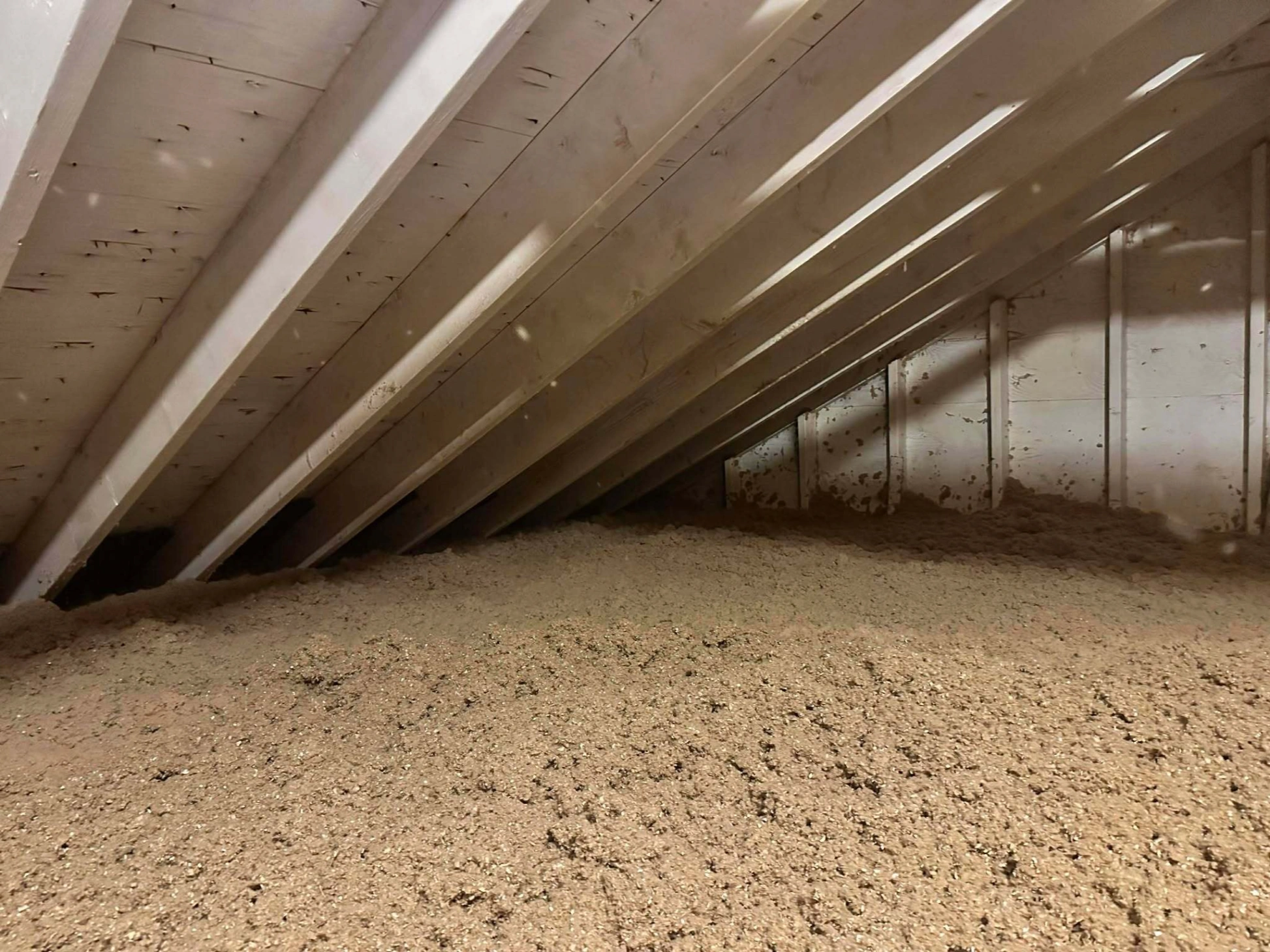
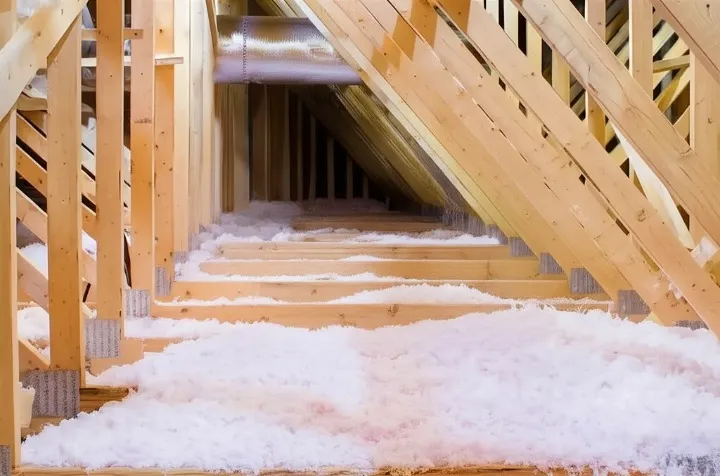
The attic is the single most important place to insulate in a home. Since heat rises, a poorly insulated attic is like an open window for your heating dollars in the winter. In the summer, the sun beats down on the roof, superheating the attic and radiating that heat down into your living space. Blown-in insulation is perfect for attics because it easily covers the entire attic floor, including hard-to-reach corners and over the top of ceiling joists, eliminating the thermal bridging that happens when joists are left exposed.
Wall Cavities
For existing homes with uninsulated walls, the dense-pack method is a game-changer. Instead of tearing down drywall, professionals can drill small holes from the exterior or interior and blow insulation into the empty stud bays. The material is packed in tightly to prevent settling and creates a solid wall of insulation. This can dramatically improve comfort and reduce drafts coming from outlets and windows.
Expert Tip: Before insulating closed walls, it’s a good idea to use an infrared camera to check for any obstructions, like fire-blocking or old wiring, that could prevent the cavity from filling completely.
Floors and Crawl Spaces
Floors over unconditioned spaces like garages or vented crawl spaces are another major source of heat loss and cold drafts. Applying blown-in insulation to the underside of the floor (held in place by netting) can make the rooms above much more comfortable underfoot. It also helps block moisture and cold air from rising into the home from the crawl space.
Blown-In Insulation in Commercial Spaces
The principles of thermal performance are the same for commercial buildings, but the scale is often much larger. Blown-in insulation offers an efficient and cost-effective way to insulate vast areas common in commercial construction.
Large, Open Attics and Roof Decks
Warehouses, retail stores, and office buildings often have enormous, flat-roof structures with complex support systems. Installing batts in these spaces is slow and leaves many potential gaps around steel trusses and ductwork. Blown-in insulation can be installed quickly over massive areas, providing a consistent thermal barrier that lowers the building’s heating and cooling load. Properly insulating a commercial building can have a massive impact on overhead costs; in fact, the U.S. Environmental Protection Agency states that energy efficiency measures can reduce energy consumption in commercial buildings by an average of 30 percent.
Masonry Block Walls
Many commercial structures are built with concrete masonry units (CMU), or cinder blocks. The hollow cores inside these blocks create a direct path for heat to travel through the walls. Blown-in insulation can be used to fill these cores during construction or even in existing buildings, significantly boosting the wall’s overall R-value and thermal performance.
Soundproofing in Offices and Multi-Family Units
In office buildings, apartments, and hotels, noise control is just as important as thermal control. The dense nature of cellulose and mineral wool makes them highly effective at absorbing sound waves. Using these materials in interior walls and between floors can drastically reduce noise transfer between units, creating a quieter and more private environment for tenants and employees.
The Installation Process: A Step-by-Step Overview
While the concept is straightforward, a professional installation is methodical and requires specialized equipment to ensure the job is done right. An improper installation can lead to gaps, settling, and poor performance.
Preparation and Safety: The first step is always a thorough inspection. Installers will identify and seal any air leaks in the attic floor or walls, such as those around light fixtures, plumbing stacks, and wiring penetrations. This is a critical step because insulation works best in a sealed air space. [Link to: Air Sealing: The Critical First Step Before Insulating] They will also install baffles near the soffit vents to ensure that the new insulation doesn’t block airflow from the eaves, which is needed for proper attic ventilation.
The Blowing Machine and Equipment: A large blowing machine is typically mounted in a truck outside the building. One crew member feeds bags of insulation into the machine’s hopper, while another is inside the application area with the hose. The machine uses air to fluff up the material and send it through the hose at a consistent rate.
Application Techniques: For an open-blow attic application, the installer directs the hose to spray the material evenly across the entire surface, building it up to the desired depth. Rulers are often placed throughout the attic to ensure a consistent thickness and the correct final R-value. For dense-packing walls, a special tube is inserted into the cavity, and the material is blown in at a high pressure (around 3.5 pounds per square foot for cellulose) to ensure it fills every void and won’t settle later.
Cleanup and Final Inspection: The process can create some dust, so professional crews will lay down tarps and contain the work area. After the installation is complete, they clean up the site and perform a final inspection to ensure the depth is correct and coverage is complete.
Key Takeaways
Proper installation must start with thorough air sealing to maximize effectiveness.
Specialized equipment is essential for achieving the correct material density and performance.
Installation methods vary for open spaces (like attics) versus closed cavities (like walls), each requiring a specific technique.
Benefits and Potential Drawbacks
Like any building material, blown-in insulation has a clear set of advantages and a few considerations to keep in mind.
The Upside: Why Choose Blown-In?
Superior Thermal Performance: Its main benefit is its ability to form a seamless blanket, which drastically reduces thermal bridging and air infiltration. This often results in higher real-world performance compared to batts of the same R-value.
Energy Efficiency: A tighter, better-insulated building requires less energy to heat and cool. This translates directly to lower utility bills and a smaller carbon footprint. The global market for insulation is growing, and analysis from Grand View Research projects continued expansion, driven largely by rising energy costs and stricter building codes.
Speed of Installation: In many cases, especially for large open areas, blown-in insulation can be installed much faster than cutting and fitting individual batts.
Excellent Sound Dampening: The materials, especially cellulose and mineral wool, are naturally effective at absorbing sound, which helps create a quieter indoor environment.
Things to Consider: Potential Downsides
Settling Over Time: Some materials, particularly lower-density fiberglass, can settle over the years, which may slightly reduce the R-value. Dense-packed cellulose is installed at a density designed to prevent this.
Dust During Installation: The process can be messy, which is why professional containment and cleanup are so important.
Moisture Sensitivity: Cellulose, being paper-based, will lose thermal resistance if it becomes wet. It is not recommended for areas with active leaks or high moisture exposure. The source of the moisture must be fixed before insulation is installed.
Understanding R-Value and Performance
R-value is a measure of a material’s resistance to heat flow. The higher the R-value, the better it insulates. With blown-in insulation, the final R-value is determined by two things: the type of material used and its installed depth. An installer can achieve almost any desired R-value simply by blowing in more material.
Building codes provide recommendations for R-values based on your climate zone. The colder the climate, the higher the recommended R-value.
Expert Tip: Many states and utility companies offer rebates or tax credits for improving your home’s insulation. Check local programs before starting a project, as it can significantly reduce the overall cost.
Recommended R-Values by Location
Location in Building
Climate Zones 2-3 (e.g., FL, TX)
Climate Zones 4-5 (e.g., VA, IL)
Climate Zones 6-7 (e.g., WI, ME)
Attic
R38 – R49
R49 – R60
R49 – R60
Walls (2×4)
R13 – R15
R13 – R15
R13 – R15
Walls (2×6)
R20 – R21
R20 – R21
R20 – R21
Floors/Crawl Spaces
R13
R25 – R30
R25 – R30
This table is based on general recommendations. Lamothe Spray Foam Insulation can provide specific guidance based on local building codes and your property’s needs.
Common Challenges and Professional Solutions
Achieving optimal performance with blown-in insulation means addressing a few common issues that can arise, especially in older buildings.
Dealing with Existing Insulation
In many attics, there’s already some old, compressed insulation. As long as it’s dry and free of mold, new blown-in insulation can usually be installed directly on top of it. This adds to the total R-value and is much more cost-effective than a full removal. However, if the existing insulation is wet, contaminated by pests, or made of hazardous material like vermiculite (which could contain asbestos), it must be professionally removed first.
Preventing Voids and Gaps
The skill of the installer is paramount. They need to understand how to maneuver the hose to get insulation behind pipes, around electrical boxes, and into tight corners. An inexperienced installer might leave voids that compromise the thermal barrier. Using the proper pressure and a systematic application pattern ensures complete and even coverage.
Managing Moisture and Ventilation
Insulation and ventilation go hand in hand. In attics, it’s essential that soffit vents at the eaves are not blocked by insulation. Professionals install baffles or rafter vents to maintain a clear channel for air to flow from the soffits to the ridge vent. This airflow prevents moisture buildup in the winter and reduces heat accumulation in the summer, protecting the roof structure and maintaining the insulation’s effectiveness.
Expert Tip: Proper ventilation is just as important as the insulation itself. Without it, you risk creating moisture problems that can lead to mold and rot. Always ensure your attic has a balanced intake (soffit vents) and exhaust (ridge or gable vents) system.
Putting Your Insulation Strategy into Action
You now have a complete picture of what blown-in insulation is, how it works, and where it can be used to make a real difference in a building’s performance. From the eco-friendly toughness of cellulose to the fire-stopping power of mineral wool, there is a material and an application technique to solve nearly any insulation challenge. The key is understanding that effective insulation isn’t just about adding material; it’s about creating a complete, gap-free thermal barrier that also manages air and moisture.
Whether you’re looking to lower your home’s energy bills, quiet a noisy office, or ensure your new construction project meets the highest efficiency standards, blown-in insulation is a powerful and flexible solution. Use this guide as your reference to ask the right questions and make an informed decision for your property.
Need Expert Guidance?
Navigating the details of a spray foam insulation project can be complex. If you have questions about your specific situation or would like a professional assessment of your home or commercial property, the team at Lamothe Spray Foam Insulation is here to help. For a consultation, you can reach us by phone at (508) 847-0119 or send an email to [email protected].
Frequently Asked Questions About Blown-In Insulation
How long does blown-in insulation last?
When installed correctly in a dry, well-ventilated space, blown-in insulation can last for the life of the building. The materials themselves do not break down, but performance can be reduced by settling or moisture damage.
Is blown-in insulation a fire hazard?
No. All three primary materials have excellent fire-safety ratings. Fiberglass and mineral wool are naturally non-combustible. Cellulose is treated with borates, giving it a Class A fire rating, meaning it will char and smolder but not support a flame.
Can I install blown-in insulation myself?
While DIY machines are available for rent, it’s a project best left to professionals. Achieving the correct density to prevent settling, ensuring complete coverage without voids, and handling the equipment safely are challenging without training and experience. Professionals can also perform critical air sealing that a DIYer might miss.
How much does blown-in insulation cost?
The cost depends on the material chosen, the desired R-value (which dictates the depth), the size of the area, and the complexity of the job. Generally, cellulose and fiberglass are comparable in price, while mineral wool is a more premium option.
Does blown-in insulation help with pests?
Cellulose insulation treated with borates is an effective pest deterrent. Borates are toxic to insects like cockroaches, silverfish, and termites but are safe for humans and pets. Fiberglass and mineral wool are inorganic, so they provide no food source for pests, but they don’t have active deterrent properties.
What’s the difference between dense-pack and open-blow?
Open-blow is used for unconfined spaces like attics, where the insulation is sprayed on top of a flat surface. Dense-pack is used for enclosed cavities like walls or floors, where the insulation is blown in under pressure to fill the space completely and prevent it from settling.
Mineral wool offers superior soundproofing performance compared to blown-in insulation, delivering STC ratings of 45-52 versus cellulose’s typical STC rating…
Closed-cell spray foam insulation outlasts all traditional insulation types, maintaining peak performance for 80 to 100+ years without degradation. Traditional…