How Closed-Cell Spray Foam Creates a Continuous Air Seal in Worcester, MA
Closed-cell spray foam creates a continuous air seal by applying liquid polyurethane that expands up to 60 times its original…


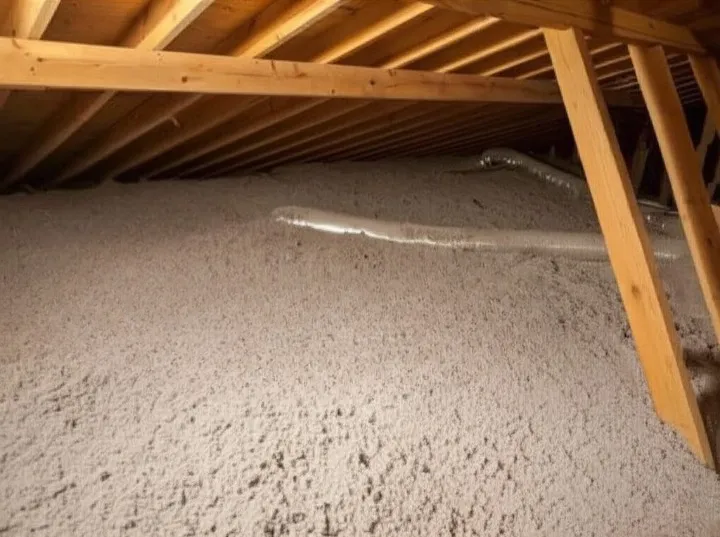
Blown-in cellulose delivers a better R-value per inch than blown-in fiberglass. Cellulose settles in at R-3.2 to R-3.8 per inch, while blown-in fiberglass comes in at R-2.2 to R-2.7 per inch according to the Department of Energy’s Building America Solution Center. That means cellulose provides roughly 30 to 40 percent more thermal resistance per inch of thickness. In practical terms, cellulose achieves R-38 in about 10 to 12 inches, whereas fiberglass needs 14 to 17 inches to hit the same target. However, the comparison is not that simple. Fiberglass is lighter, resists moisture damage better, and does not settle as aggressively over time. Cellulose is denser, fills irregular cavities more effectively, and provides better resistance to air movement. Both materials are widely used in residential and commercial insulation projects, and the right choice depends on the specific project conditions, climate zone, and installation method.
The numbers from the Department of Energy’s Building America Solution Center tell a clear story when it comes to loose-fill applications in attics. Here is how the two materials stack up side by side:
| Property | Blown-in Cellulose | Blown-in Fiberglass |
|---|---|---|
| R-value per inch | 3.2 to 3.8 | 2.2 to 2.7 |
| Depth needed for R-38 | 10 to 12 inches | 14 to 17 inches |
| Settled density | 1.5 to 2.0 lb/ft3 | 0.5 to 1.0 lb/ft3 |
| Settling rate | 10 to 20 percent | 2 to 4 percent |
| Weight at R-38 | 1.25 to 2.0 lb/ft2 | 0.5 to 1.2 lb/ft2 |
| Air flow resistance | Good | Low |
| Moisture damage risk | Breaks down when saturated | Recovers when dried |
The R-value advantage for cellulose is meaningful. In a standard attic floor application where depth is limited by code or structural constraints, cellulose delivers more thermal resistance in less space. This matters in retrofit situations where the existing framing or roof pitch restricts how much insulation can be added.
The comparison shifts when we look at dense-pack wall installations rather than loose-fill attic applications. Dense-pack methods involve forcing insulation into closed wall cavities at higher pressures and densities, preventing settling and filling gaps around wires, pipes, and obstructions.
According to the Building America Solution Center’s Dense-Pack Insulation resource, dense-packed cellulose delivers R-3.2 to R-3.5 per inch at an installed density of 3.5 to 4.5 lb/ft3. Dense-packed fiberglass, by contrast, achieves R-4.2 per inch at a density of 1.8 to 2.6 lb/ft3.
| Installation Method | Cellulose R-value/inch | Fiberglass R-value/inch | Recommended Density |
|---|---|---|---|
| Loose-fill attic | 3.2 to 3.8 | 2.2 to 2.7 | Per manufacturer spec |
| Dense-pack wall | 3.2 to 3.5 | 4.2 | 3.5 to 4.5 lb/ft3 (cellulose), 1.8 to 2.6 lb/ft3 (fiberglass) |
In dense-pack applications, fiberglass actually pulls ahead on a per-inch basis. The higher density eliminates the air voids that reduce fiberglass performance in loose-fill applications, allowing the material to reach its full thermal potential. However, cellulose at dense-pack density still fills cavities more completely and provides better resistance to air infiltration through the wall assembly.
One of the most frequently cited differences between these two materials comes from research conducted by Oak Ridge National Laboratory (ORNL). The ORNL study tested both materials in a simulated attic assembly under winter conditions, keeping the indoor side at 70 degrees Fahrenheit while dropping the outdoor side to minus 18 degrees.
The results were striking. Loose-fill fiberglass showed thermal resistance reductions of 35 to 50 percent at the largest temperature differences, a phenomenon attributed to natural convection currents within the insulation. Cold, dense air from the attic was penetrating the loose fiberglass, circulating through the material, and carrying heat away from the ceiling below. Cellulose showed no such convection problem due to its higher density and lower air permeability.
It is worth noting that this ORNL study was conducted on early 1990s loose-fill fiberglass products. As Energy Vanguard has documented, fiberglass manufacturers subsequently changed their production methods, using smaller, unbonded chunks that nest together and reduce the air permeability that caused convection loops. Modern fiberglass products may not experience the same R-value drop, though independent testing on current products remains limited.
Every insulation project comes with its own set of constraints. Here are five realistic scenarios showing how the R-value comparison plays out in actual jobs:
| Scenario | Property Type | Recommended Option | Reasoning |
|---|---|---|---|
| Attic top-up with limited depth | 1960s ranch, flat ceiling at 2×6 joists | Blown-in cellulose | Higher R-value per inch maximizes thermal resistance in shallow cavities |
| Retrofit uninsulated walls | Pre-1950s two-story colonial, plaster walls | Dense-pack cellulose | Fills around obstructions, reduces air infiltration, adds 26 to 74 percent air tightness improvement per University of Colorado testing |
| New construction wall cavities | Modern production home, open 2×6 framing | Dense-pack fiberglass | Higher R-value per inch at dense-pack density, lighter weight reduces drywall stress |
| Open attic with no depth limits | Large attic, clear span trusses | Either material, or both | Depth is not restrictive; both materials can achieve R-49 or higher per ENERGY STAR guidelines |
| Mobile home ceiling insulation | Manufactured housing retrofit | Blown-in fiberglass | Lighter weight; cellulose is not recommended for mobile home ceilings per DOE guidance |
The best insulation choice depends on more than just the R-value per inch. Several variables affect real-world performance and long-term value:
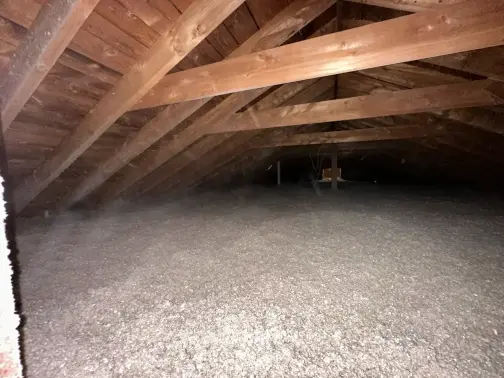
The EPA’s Identifying Greener Insulation guidelines highlight several factors for evaluating insulation sustainability: thermal resistance, recycled content, embodied energy, and greenhouse gas emissions. Cellulose has a clear advantage on most of these measures. It is manufactured primarily from recycled newspaper with 75 to 85 percent post-consumer recycled content. Fiberglass typically contains 20 to 40 percent recycled glass, though some products have reached higher levels.
Manufacturing cellulose requires far less energy than fiberglass. The production process involves shredding paper and adding borate fire retardants, with no need for the high-temperature furnaces required to spin glass fibers. BuildingGreen’s analysis estimates that fiberglass has roughly seven to ten times the embodied energy of cellulose on a per-R-value basis. Cellulose also biodegrades at end of life, while fiberglass does not.
Blown-in cellulose is the right choice when:
Blown-in cellulose is NOT the right choice when:
Blown-in fiberglass is the right choice when:
Blown-in fiberglass is NOT the right choice when:
Choosing between blown-in cellulose and fiberglass is not just about the R-value per inch on a label. It is about matching the right material to the right application, accounting for cavity depth, climate, moisture conditions, structural capacity, and long-term performance. Our team at Lamothe Insulation and Contracting has the experience to evaluate your specific situation and recommend the material and installation method that delivers the best results for your building.
Call us at (508) 847-0119 or email [email protected] to discuss your project. We serve homeowners and contractors throughout the area with professional blown-in insulation installations backed by real-world expertise.
Request a Free Quote | Schedule an Insulation Assessment
Yes, in standard loose-fill attic applications. Cellulose delivers R-3.2 to R-3.8 per inch while blown-in fiberglass provides R-2.2 to R-2.7 per inch. In dense-pack wall installations, fiberglass can reach R-4.2 per inch, surpassing cellulose.
Loose-fill cellulose settles 10 to 20 percent over time, which can reduce effective R-value. Dense-pack and stabilized cellulose products eliminate most settling. Fiberglass settles only 2 to 4 percent, so it retains its installed R-value better in standard attic applications.
ORNL research showed early loose-fill fiberglass lost up to 50 percent of its R-value at extreme temperature differences due to convection within the insulation. Modern fiberglass products use improved formulations to reduce this effect, though independent testing on current products remains limited.
Dense-pack cellulose is generally preferred for wall retrofits because its higher density fills cavities completely around wires and pipes, provides better air infiltration reduction, and does not require precise cavity measurements the way fiberglass batts do.
Fiberglass is not permanently damaged by water saturation and dries out with its R-value intact. Cellulose can break down and lose its insulating properties when saturated, and may require replacement if severely water-damaged.