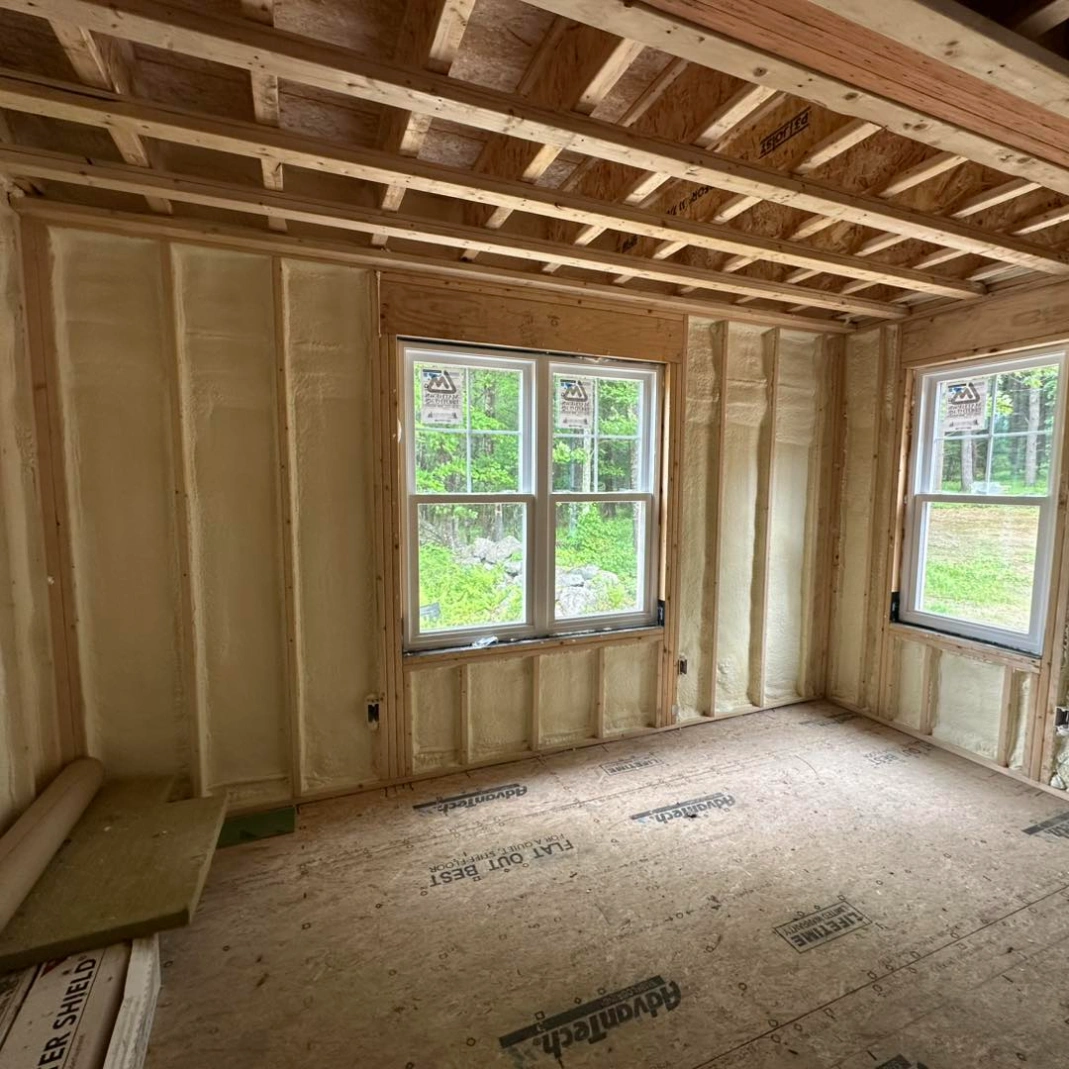
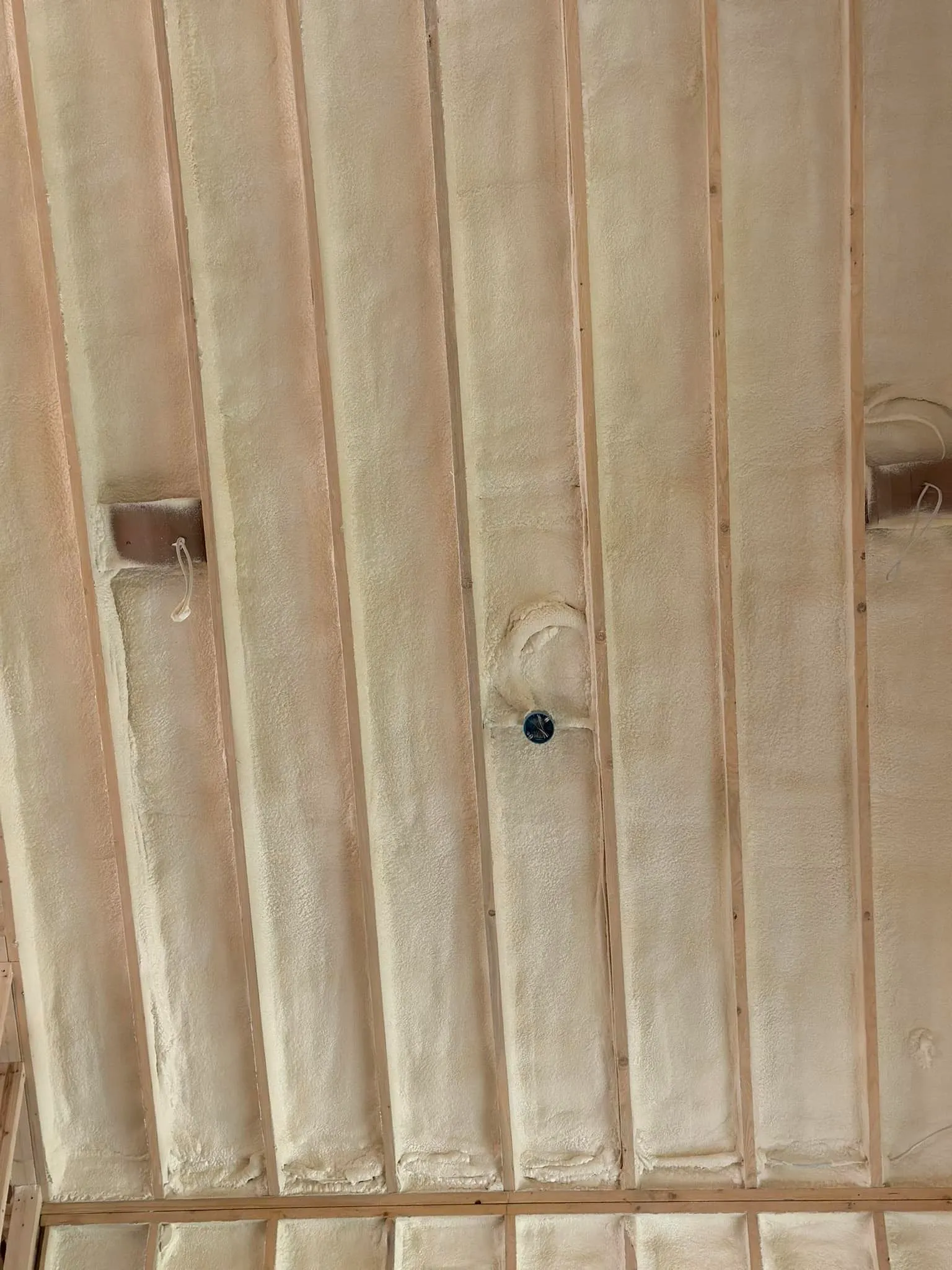
How Closed-Cell Spray Foam Creates a Continuous Air Seal in Worcester, MA
Closed-cell spray foam creates a continuous air seal by applying liquid polyurethane that expands up to 60 times its original…


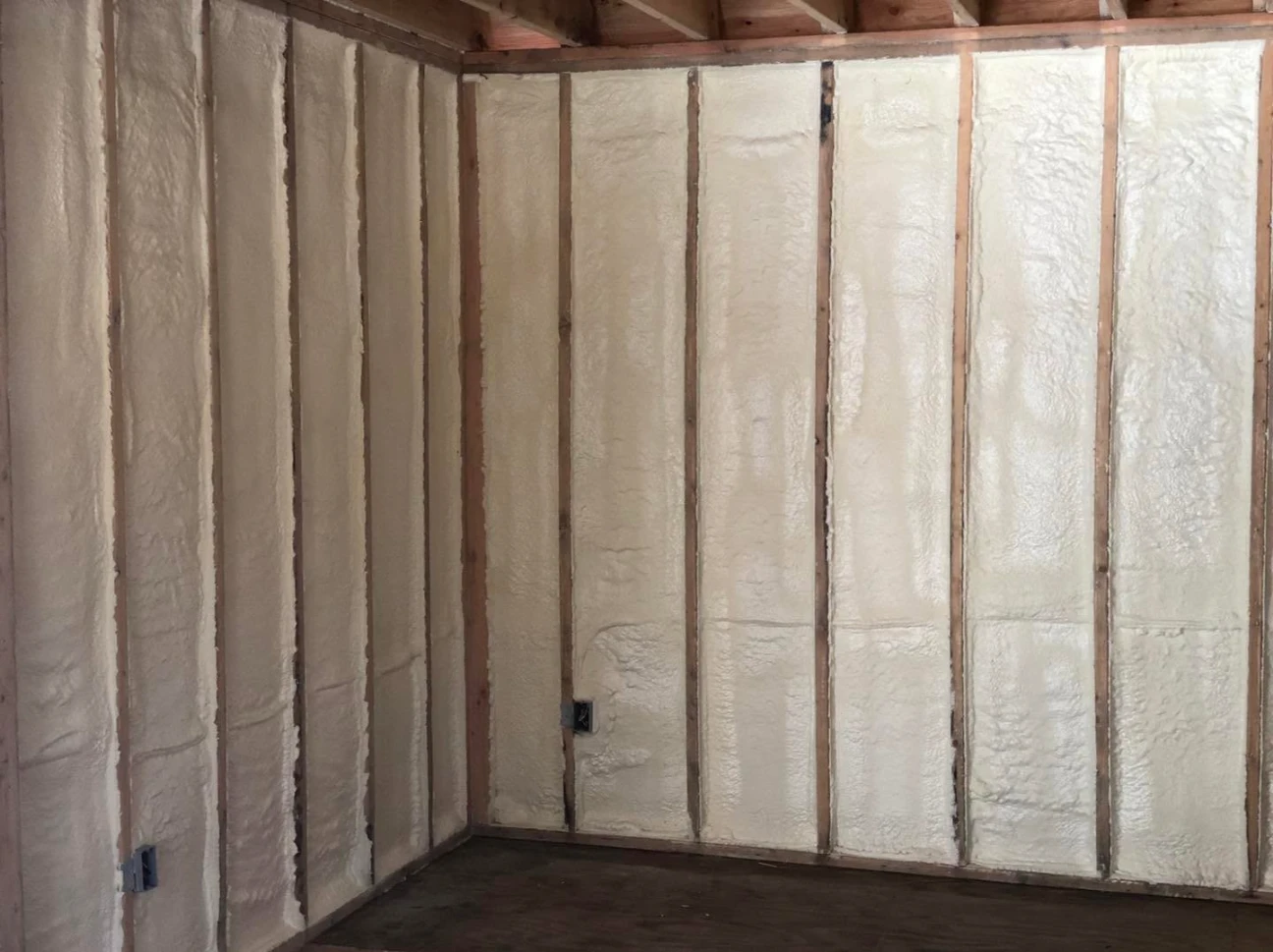
Closed-cell spray foam insulation directly reduces heat flux through wall assemblies by delivering a higher R-value per inch than nearly any other common insulation material, combined with an airtight seal that eliminates convective heat loss through gaps and penetrations. In Worcester, MA, where winter temperatures average 26.3 degrees Fahrenheit and the region falls within IECC Climate Zone 5, this reduction in heat flux has a measurable impact on heating energy demand, indoor comfort, and building durability. The right insulation strategy depends on factors like wall assembly type, cavity depth, moisture management priorities, and whether the project is new construction or a retrofit. Below, we break down the science, the specific advantages for Worcester’s climate, and what to consider before making a decision.
Heat flux, measured in watts per square meter (W/m2), describes the rate of heat energy transferring through a given surface area of a wall assembly. According to the R-value definition established in building science, R-value is the temperature difference per unit of heat flux needed to sustain one unit of heat flux between the warmer and colder surfaces of a barrier. The relationship is straightforward: heat flux equals the temperature difference across the wall divided by the total thermal resistance (R-value) of the assembly.
In practice, this means that for a given indoor-outdoor temperature difference, a wall with higher total R-value will have lower heat flux, and less heat energy will escape. In Worcester, where the average January temperature is 23.7 degrees Fahrenheit and winter averages 26.3 degrees Fahrenheit, the temperature differential between a heated living space at 68 degrees and the outdoors can exceed 40 degrees Fahrenheit for extended periods. This sustained differential makes every incremental improvement in wall R-value directly impactful on heating load.
Total wall assembly R-value is not determined by insulation alone. As DOE guidance explains, heat flows more readily through studs, joists, and other framing members in a phenomenon called thermal bridging. The overall R-value of a wall differs from the insulation’s rated R-value because of these parallel heat paths. A wall insulated with R-13 fiberglass batts between 2×4 wood studs will have a whole-wall R-value lower than 13 because of conduction through the framing.
Closed-cell spray polyurethane foam works through three distinct mechanisms to reduce heat flux, each addressed in ORNL’s comprehensive review of closed-cell foam thermal performance:
Research from ORNL notes that convective heat transport is essentially eliminated by the small cell size of closed-cell foam. This is a meaningful distinction from loose-fill or batt insulation, where air movement within cavities can contribute to heat transfer.
The net result is an insulation material rated at approximately R-5.5 to R-6.5 per inch in aged condition, which compares favorably to all common alternatives:
| Insulation Type | R-Value per Inch (Approximate) | Air Sealing Capability | Best Application |
|---|---|---|---|
| Closed-cell spray foam | R-5.5 to R-6.5 | Excellent, acts as air barrier | Wall cavities, rim joists, basements |
| Open-cell spray foam | R-3.5 to R-3.6 | Good, seals gaps | Interior wall cavities, sound control |
| Fiberglass batts | R-3.1 to R-3.4 | Poor, no air sealing | Standard cavities, attics |
| Mineral wool batts | R-3.0 to R-3.8 | Poor, no air sealing | Fire-rated assemblies, sound |
| Cellulose (loose-fill) | R-3.1 to R-3.8 | Moderate, reduces but does not seal | Retrofit wall cavities, attics |
| Extruded polystyrene (XPS) | R-5.0 to R-5.4 | None unless taped | Continuous exterior insulation |
Worcester County experiences one of the harshest winter climates in Massachusetts. According to NOAA climate normals (1991-2020), the county averages 47.6 degrees Fahrenheit annually, with winter temperatures averaging 26.3 degrees Fahrenheit and January averaging just 23.7 degrees Fahrenheit. Annual snowfall reaches 57.1 inches. These conditions place Worcester firmly in IECC Climate Zone 5, where the DOE recommends R-20 cavity insulation combined with R-5 continuous exterior insulation for new wood-frame wall construction.
In this climate, wall insulation performance has a direct and significant impact on heating energy consumption. During a typical Worcester winter, the sustained 40-plus degree temperature differential between indoors and outdoors drives continuous heat loss through every square foot of above-grade wall area. Reducing heat flux through those walls means the heating system works less to maintain comfortable indoor temperatures.
The combination of cold winters and moderate summers also means that moisture management in walls is a priority. Warm, moist indoor air meeting cold exterior surfaces creates condensation risk. Closed-cell spray foam’s vapor-retarder properties help manage this by limiting moisture diffusion into the wall cavity from the interior.
One factor that differentiates closed-cell spray foam from other insulation types is that its R-value changes over time. The ORNL review of long-term thermal performance explains that the blowing agent gases trapped within closed cells slowly diffuse out over the service life of the product, while atmospheric gases (nitrogen and oxygen) diffuse in. Since air has higher thermal conductivity than the original blowing agents, the effective R-value decreases.
Research published by the U.S. Army Engineer Research and Development Center found that closed-cell polyurethane foam experienced approximately a 27.5 percent reduction in R-value over time due to moisture absorption and loss of blowing agent. Fiberglass and extruded polystyrene, by contrast, retained over 97 percent of their initial R-values in the same study.
This aging effect means that the initial rated R-value of freshly installed closed-cell spray foam will be higher than its long-term in-service value. Building scientists and standards bodies have developed testing protocols, such as the thin-slicing method described in ASTM C1303, to predict long-term aged R-values. For Worcester homeowners, this means that energy savings projections should account for this gradual performance shift rather than relying solely on the manufacturer’s initial R-value claim.
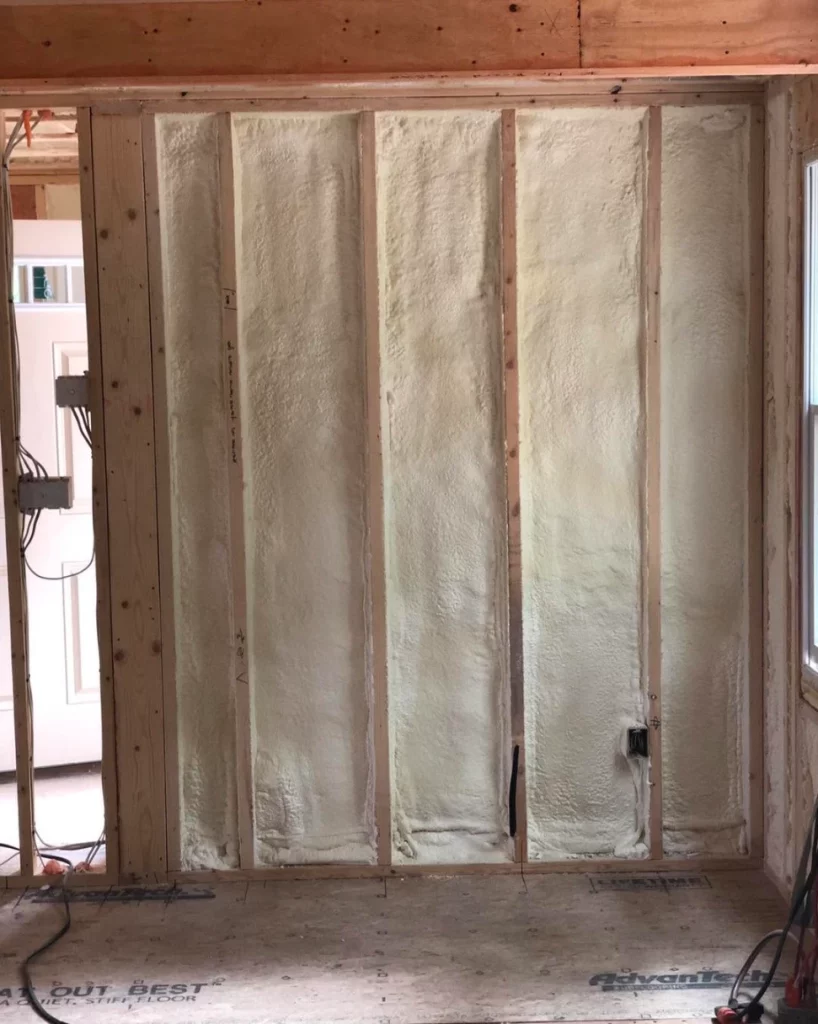
For Worcester homeowners evaluating wall insulation options, the choice involves balancing thermal performance, air sealing, moisture control, and cavity depth constraints.
| Wall Assembly Strategy | Whole-Wall Performance | Air Sealing | Moisture Control | Cavity Depth Needed |
|---|---|---|---|---|
| Closed-cell spray foam (full cavity) | High per-inch R-value in cavity | Excellent, integrated | Acts as vapor retarder | 3 to 3.5 inches reaches R-20+ |
| Fiberglass batts + exterior rigid foam | Good total R with CI | Requires separate air sealing | Depends on detailing | Full cavity depth + continuous layer |
| Blown cellulose (retrofit) | Moderate, settles over time | Moderate | Variable, depends on vapor barrier | Full cavity, existing construction |
| Open-cell spray foam + exterior rigid | Moderate cavity R, good with CI | Good cavity sealing | Vapor-open, needs exterior retarder | Full cavity + continuous layer |
The right approach depends on the specific project. New construction offers the flexibility to combine cavity insulation with continuous exterior insulation for the highest whole-wall performance. Retrofit projects in existing Worcester homes often benefit most from closed-cell spray foam because it provides both insulation and air sealing in a single application, without requiring exterior siding removal.
For new homes, we recommend closed-cell spray foam in wall cavities combined with continuous exterior rigid insulation. This dual-layer approach addresses both cavity conduction and thermal bridging through framing. The DOE’s recommendation for Climate Zone 5 calls for this combination, and it represents the highest practical wall performance achievable within standard construction methods.
For existing Worcester homes with empty or under-insulated wall cavities, closed-cell spray foam installed through the interior or during a re-siding project provides the most impactful single upgrade. The material fills voids around wiring, plumbing, and framing irregularities that batt insulation cannot address, and the air-sealing benefit compounds the thermal resistance improvement.
Closed-cell spray foam is particularly effective in basement walls and rim joist areas, where moisture resistance and air sealing are both priorities. The foam adheres directly to concrete, masonry, and wood substrates, creating a continuous seal against both heat loss and moisture intrusion.
Understanding how closed-cell spray foam reduces heat flux in your wall assemblies requires a site-specific evaluation of your current insulation, air sealing, and building construction. Our team at Lamothe Insulation and Contracting has extensive experience working with Worcester-area homes and buildings in Climate Zone 5, and we can provide a detailed assessment of your wall systems and insulation options. Request a Free Quote for your insulation project or Schedule a Wall System Assessment to have our professionals evaluate your current heat loss and recommend the most effective approach. Call us at (508) 847-0119 or email [email protected] to get started.
A: At the same cavity depth, closed-cell foam delivers roughly double the R-value of fiberglass, which roughly halves the conductive heat flux. The additional air-sealing benefit further reduces convective losses that fiberglass cannot address.
A: Yes, as blowing agents diffuse out and are replaced by air, the R-value decreases. U.S. Army ERDC research documented approximately a 27.5 percent reduction in closed-cell polyurethane foam R-value over the service life of the material.
A: Worcester is in IECC Climate Zone 5, where the DOE recommends R-20 cavity insulation plus R-5 continuous exterior insulation for new wood-frame walls. Existing uninsulated wood-frame walls should be insulated to at least R-13.
A: Yes, closed-cell foam can be installed in existing walls either from the interior by drilling access holes or from the exterior when re-siding. The foam expands to fill gaps and irregular spaces around framing, wiring, and plumbing.
A: Closed-cell foam acts as a vapor retarder, limiting moisture diffusion from warm indoor air into wall cavities where it could condense on cold surfaces. This is particularly relevant in Worcester’s cold, humid winter conditions.