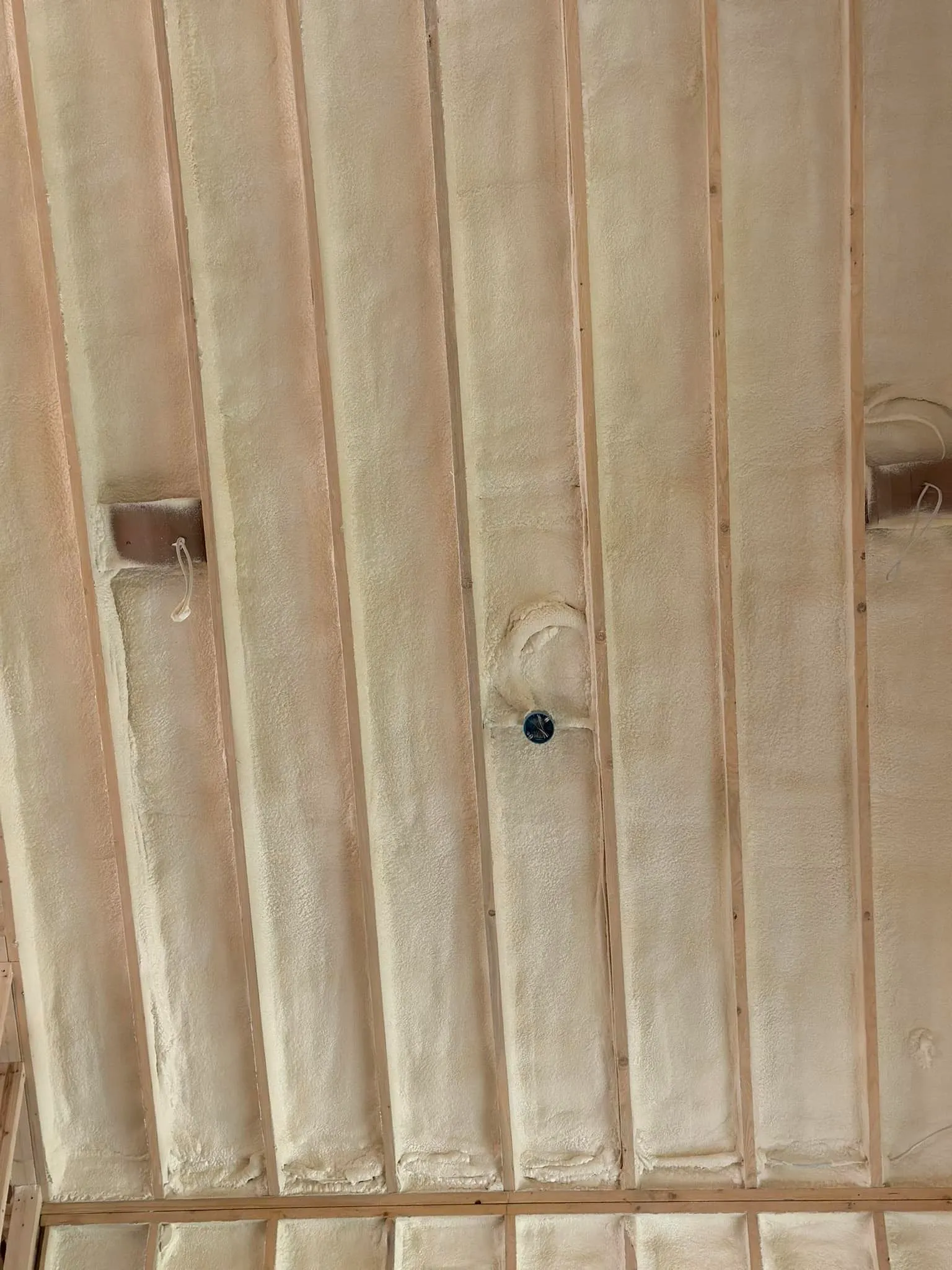
How Closed-Cell Spray Foam Creates a Continuous Air Seal in Worcester, MA
Closed-cell spray foam creates a continuous air seal by applying liquid polyurethane that expands up to 60 times its original…



Spray foam insulation installation delivers the highest per-inch thermal resistance of any commercially available insulation material, making it the preferred choice for cold storage buildings in New Braintree, MA, where winter lows routinely drop to 17 degrees Fahrenheit and heating degree days place the region squarely in IECC Climate Zone 5A. For cold storage applications, the material choice comes down to closed-cell spray polyurethane foam (SPF), which provides a combination of high R-value per inch, air sealing, and moisture vapor barrier performance that other insulation types cannot match in a single product. The right approach depends on your building’s specific operating temperature, envelope construction, and whether you need to meet standard code minimums or the more demanding ASHRAE 90.1 benchmarks for refrigerated facilities.
New Braintree is in Worcester County, where the Massachusetts Energy Code classifies the entire state as Climate Zone 5A per Massachusetts Commercial Energy Code Section C301. This classification carries specific implications for commercial insulation design. Climate Zone 5 demands higher minimum R-values for walls, roofs, and floors compared to warmer zones, and Massachusetts also enforces mandatory air leakage testing at or below 3 air changes per hour (ACH50).
For cold storage buildings, this means the exterior envelope faces a steep temperature differential between conditioned interior space and the harsh New England exterior. January average lows in the Worcester area reach approximately 17 degrees Fahrenheit, with annual snowfall averaging 64 inches. That combination of cold, humid exterior air and sub-freezing interior temperatures for freezer facilities creates an environment where thermal bridging, air infiltration, and moisture condensation become serious problems if the insulation system is not properly designed and installed.
When selecting spray foam for cold storage, the choice between closed-cell and open-cell is straightforward. Closed-cell spray polyurethane foam is the only type appropriate for cold storage envelopes, and here is why:
| Property | Closed-Cell SPF | Open-Cell SPF |
|---|---|---|
| R-value per inch | R-6.0 to R-7.0 (DOE: up to R-7 to R-8) | R-3.5 to R-3.8 |
| Density | Approximately 2 lb/ft3 | Approximately 0.5 lb/ft3 |
| Vapor barrier | Yes (Class II vapor retarder) | No (vapor permeable) |
| Air barrier | Yes | Yes |
| Structural rigidity | Adds wall-racking strength | Soft, flexible, non-structural |
| Suitability for cold storage | Recommended | Not recommended |
Open-cell foam expands over 100 times its liquid volume and provides good air sealing and sound absorption, but its low R-value per inch and vapor-permeable nature make it unsuitable for cold storage envelopes. In a cold storage building, moisture control is not optional. Warm exterior air infiltrating through gaps or permeable insulation will condense on cold surfaces, leading to insulation degradation, mold growth, and structural damage over time.
Closed-cell SPF, by contrast, forms a dense, rigid material that acts as both an air barrier and a vapor retarder in a single application. The DOE data cited by InterNACHI places its initial R-value at approximately R-7 to R-8 per inch, making it the highest-performing spray-applied insulation available. While thermal drift causes a gradual decline as low-conductivity gas escapes and is replaced by air, most of this drift occurs within the first two years, and the foam then stabilizes.
Cold storage buildings are not governed by the same code requirements as standard commercial occupancies. They fall under ASHRAE Standard 90.1, which provides minimum energy efficiency requirements for commercial and high-rise residential buildings and forms the basis for most state energy codes in the United States. ASHRAE 90.1 sets prescriptive envelope requirements organized by climate zone, covering opaque walls, roofs, floors, and fenestration.
For cold storage facilities specifically, thermal performance targets are driven by the internal operating temperature rather than just the exterior climate:
With closed-cell spray foam delivering R-6.0 to R-7.0 per inch, reaching these targets requires practical application thicknesses of approximately 4.3 to 5 inches for coolers and 6.4 to 7.5 inches for freezers. This is achievable through multiple spray passes, which is standard practice in commercial SPF installations.
The defining advantage of closed-cell spray foam for cold storage is its ability to serve three roles in a single material. In traditional construction, achieving proper cold storage envelope performance requires separate layers of insulation, a dedicated vapor retarder, and meticulous air sealing at every joint, seam, and penetration. Spray foam combines all three:
Thermal insulation. The high R-value per inch reduces the wall and roof assembly thickness needed to meet ASHRAE requirements, preserving interior floor space compared to fiberglass batts or rigid board systems.
Air barrier. As the U.S. Department of Energy notes, reducing uncontrolled air leakage is one of the most cost-effective ways to cut heating and cooling costs. In cold storage, air leaks are especially damaging because they allow warm, moisture-laden exterior air to enter the conditioned space, forcing refrigeration equipment to work harder and introducing condensation risk.
Vapor retarder. Closed-cell foam has a low permeance rating that classifies it as a vapor retarder, preventing moisture drive through the building envelope. In Climate Zone 5A, where the exterior environment is cold and humid for much of the year, this is essential for preventing hidden condensation within wall and roof assemblies.
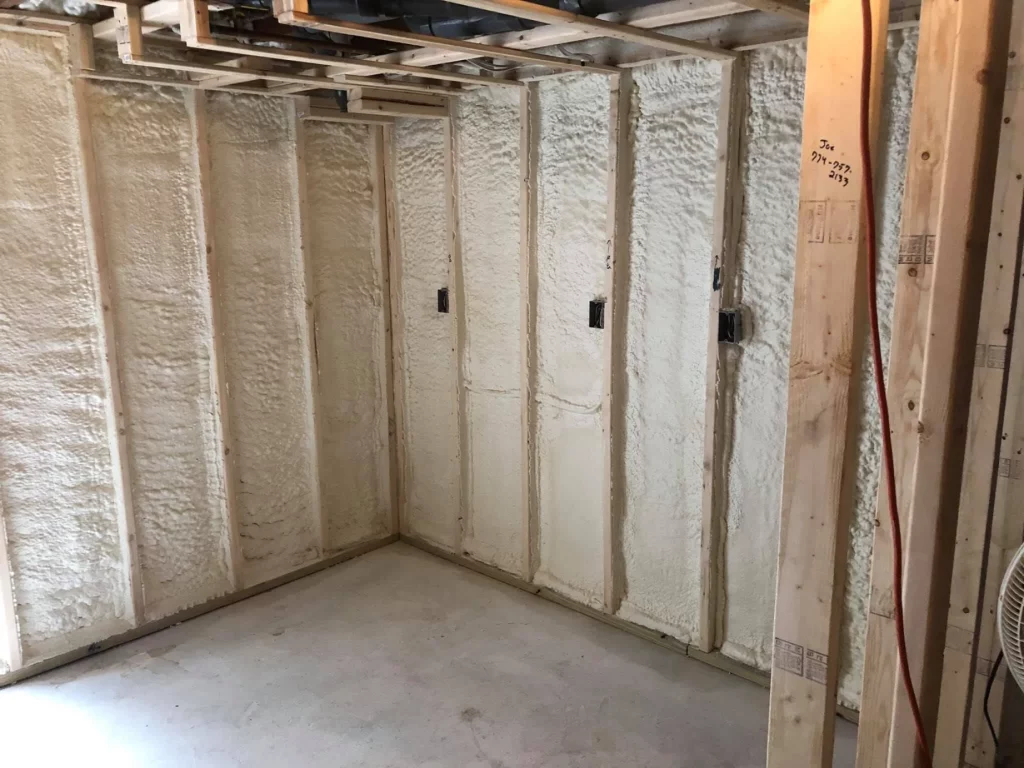
Our team applies spray foam to several critical areas within cold storage envelopes, each serving a specific function in the overall thermal performance system:
Walls and ceilings. These are the primary thermal barrier surfaces. Multiple passes of closed-cell SPF are applied to achieve the target assembly R-value while forming a continuous air and vapor seal.
Roof-to-wall junctures. Junctions where the roof meets the wall are common thermal bridge and air leakage points. Spray foam conforms to irregular shapes and seals these transitions completely.
Floor-to-wall junctions. The intersection of insulated floor panels and walls is another vulnerable penetration point. Foam-in-place application seals this juncture against air and moisture infiltration.
Penetrations and utility openings. Pipes, conduit, and structural elements passing through the envelope create gaps that traditional insulation cannot seal. Spray foam expands to fill these voids completely.
The Massachusetts Building Energy Code requires that the state update its building energy code every three years to remain consistent with the latest International Energy Conservation Code (IECC). Massachusetts was the first state to adopt a “Stretch Code” above the base requirements, emphasizing energy performance over prescriptive specifications. For commercial buildings, the base code is IECC 2021 with Massachusetts amendments (780 CMR Chapter 13), and municipalities may opt into the Stretch Code (225 CMR Chapter 23) with stricter performance requirements.
For spray polyurethane foam installations specifically, the code mandates that installers provide a certification listing the installed thickness and R-value of SPF in each element of the building thermal envelope. This certification must be signed, dated, and posted conspicuously at the job site. Our team handles all documentation and compliance requirements so building owners and facility managers do not have to manage code paperwork.
| Facility Type | Recommended SPF Approach | Minimum R-Value Target | Key Considerations |
|---|---|---|---|
| Walk-in coolers (32-55F) | Closed-cell, 2-pass application | R-30 assembly | Focus on door gaskets and junction sealing |
| Freezer storage (-20 to 25F) | Closed-cell, 3-pass application | R-45 assembly | Extra attention to vapor barrier continuity |
| Cold distribution warehouses | Closed-cell continuous | R-30 to R-38 | High traffic doors increase air exchange |
| Agricultural cold storage | Closed-cell on walls and ceiling | R-25 to R-30 | Consider seasonal temperature fluctuations |
Selecting a qualified insulation contractor for cold storage work goes beyond general insulation experience. Look for these indicators:
Lamothe Insulation and Contracting delivers expert spray foam insulation for cold storage buildings throughout New Braintree and the surrounding Central Massachusetts area. Our team evaluates your facility’s operating temperature, envelope construction, and code requirements to design a spray foam application that meets ASHRAE thermal targets while providing the air sealing and moisture control your refrigerated space demands.
Request a Free Quote | Schedule a Thermal Assessment
Call us at (508) 847-0119 or email [email protected] to discuss your cold storage insulation project. We are ready to help you build an envelope that performs.
What R-value do I need for a cold storage building in Massachusetts?
Coolers maintaining 32 to 55 degrees Fahrenheit need a minimum R-30 assembly, while freezers operating below 32 degrees require R-45 or higher, per ASHRAE 90.1 commercial envelope standards.
Can open-cell spray foam be used in cold storage applications?
Open-cell foam is not recommended for cold storage because it is vapor-permeable and has a significantly lower R-value per inch (R-3.5 to R-3.8) compared to closed-cell, which also provides vapor retarder properties.
Does spray foam eliminate the need for a separate vapor barrier?
Closed-cell spray foam acts as a vapor retarder, which in most cold storage applications eliminates the need for a separate vapor barrier membrane, though specific conditions may require additional vapor control depending on the design.
How thick should spray foam be applied in a freezer facility?
To achieve R-45 in a freezer, closed-cell spray foam at R-6.0 to R-7.0 per inch requires approximately 6.5 to 7.5 inches of total thickness, typically applied in multiple passes.
What code requirements apply to spray foam insulation in Massachusetts?
Massachusetts requires SPF installers to certify the installed thickness and R-value for each building envelope element, with documentation signed, dated, and posted conspicuously at the job site under the Massachusetts Energy Code.