How to Address Uneven Insulation Coverage With Open-Cell Spray Foam in Worcester, MA
Fixing uneven insulation coverage with open-cell spray foam in Worcester, MA starts with diagnosis, not with more foam. Our team…


Poor spray foam performance almost always traces back to a handful of preventable issues: incorrect foam selection for the climate zone, improper mixing and application during installation, inadequate substrate preparation, temperature and humidity violations during spraying, and failure to address ventilation and moisture management after the building envelope is tightened. When any of these factors are overlooked, the insulation underperforms on R-value, air sealing, and moisture control, leaving homeowners with higher energy bills, comfort complaints, and potential structural damage. This is closely tied to how insulation impacts protection, moisture control, and health benefits in general. For a deeper breakdown, read our guide on insulation and property protection.
Spray polyurethane foam (SPF) is unique among insulation materials because it can simultaneously provide water control, air control, vapor control, and thermal control within a single application. As the Building Science Corporation’s Residential Spray Foam Guide explains, houses are environmental separators that keep the outside out and the inside in. Spray foam creates continuity across all four control layers when specified and installed correctly.
The two primary types of spray foam insulation serve different purposes:
| Foam Type | R-Value per Inch | Density | Air Barrier | Vapor Retarder | Best Application |
|---|---|---|---|---|---|
| Closed-Cell (High Density) | R-6 to R-7 | 1.5-2.0+ lbs/ft3 | Yes | Class II at 1.5 inches | Cold climates, foundations, crawlspaces, and unvented roofs |
| Open-Cell (Low Density) | R-3.5 to R-3.7 | 0.5-0.7 lbs/ft3 | Yes | Vapor permeable | Sound control, interior walls, warm climates |
When these materials perform as designed, they deliver exceptional energy efficiency and comfort. The problems arise when the installation process or product selection goes wrong.
Using open-cell foam in a cold climate is one of the most damaging mistakes a contractor can make. According to Building Science Corporation, in IECC Climate Zones 5 and higher, only high-density closed-cell spray foam should be used in unvented conditioned attics and on the interior of vented crawlspaces. Closed-cell foam at the right thickness acts as a Class II vapor retarder (rated at 1 perm or less) and prevents condensation from forming within wall and roof assemblies when warm, moist indoor air meets cold exterior surfaces.
Open-cell foam, while an excellent air barrier, is vapor-permeable. In heating-dominated climates, that permeability allows interior moisture to migrate into wall and roof cavities where it can condense on cold sheathing, leading to rot, mold, and structural decay. The fix is straightforward: match the foam type and thickness to the climate zone per IRC Table 702.7.1 for walls and Table R806.5 for roofs.
Spray foam insulation is created by combining two chemical components (an isocyanate side-A and a polyol resin side-B) in precise proportions at the spray gun. When the ratio drifts off spec, the foam cures improperly. Symptoms of off-ratio application include:
The Journal of Light Construction’s troubleshooting guide for spray foam identifies poor adhesion, density irregularities, and voids as the primary visual indicators of application failures. Our technicians verify the mix ratio regularly during every job by checking foam samples for proper rise, color, and cell structure.
Spray foam requires specific temperature conditions to cure and bond correctly. The optimal substrate temperature range falls between 60 degrees F and 90 degrees F for most formulations, though some cold-weather grades can tolerate substrate temperatures down to 20 degrees F. Ambient air temperature, humidity, and dew point all affect the reaction chemistry.
When surfaces are too cold, the foam expands sluggishly, fails to bond, and may not fill cavities completely. When temperatures are too high, the foam cures too fast, leading to shrinkage cracks and voids. If the ambient temperature is within 5 degrees F of the dew point, moisture accumulates on the substrate surface and prevents adhesion entirely.
Proper preparation means verifying substrate temperature with an infrared thermometer before spraying, using temporary heat sources during cold-weather installations, and monitoring conditions throughout the job.
Spray foam must meet minimum thickness requirements to deliver its rated performance. The International Residential Code specifies minimum R-values for condensation control that vary by climate zone and framing type. For example, in Climate Zone 5, closed-cell spray foam applied to the interior of wood sheathing in a 2×4 wall must meet specific minimum R-value requirements per IRC Table 702.7.1.
Common thickness-related failures include:
Spray foam adheres best to clean, dry surfaces free of dust, oil, frost, and loose material. When our crew encounters surfaces with standing water, frost, or heavy contamination, we stop and correct the condition before proceeding. Spraying over damp or dirty substrates causes immediate adhesion failure and long-term performance degradation.
Construction debris, sawdust, and form release agents on concrete foundations are frequent culprits. In new construction, scheduling insulation installation after other trades have completed their work (or after a thorough cleaning) prevents many of these problems.
Spray foam foam insulation experiences some degree of thermal drift, which is the gradual loss of R-value as the blowing agents within the foam cells diffuse out and are replaced by air. According to Wikipedia’s R-value reference, research indicates that the R-values of insulation products may deteriorate over time, and the industry has developed Long Term Thermal Resistance (LTTR) testing to account for this phenomenon.
Closed-cell spray foam can lose 10-15% of its initial R-value within the first two years as the high-performance blowing agent escapes the cells. Open-cell foam is less affected because it uses air as the primary blowing agent from the start. Designing assemblies with the aged R-value in mind (rather than the initial labeled R-value) ensures the insulation still meets code and performance targets over the life of the building.
Spray foam creates a remarkably tight building envelope. That tightness is excellent for energy efficiency but creates a new problem: without adequate mechanical ventilation, moisture from cooking, bathing, and breathing accumulates indoors and can condense within wall and roof assemblies.
Building Science Corporation’s guide specifically addresses this for unvented conditioned attics, recommending that air be exhausted from the attic peak using a ducted fan while supply air is provided from outside to the return side of the air handler. This balanced ventilation approach removes moisture while maintaining air quality. Failing to plan for ventilation after tightening the envelope with spray foam is one of the most common oversights in residential construction.
Beyond thermal performance, poorly installed spray foam can create serious health risks. The EPA’s archive on spray polyurethane foam health concerns documents that exposure to isocyanates during and after installation may cause skin, eye, and lung irritation, asthma, and chemical sensitization. The Consumer Product Safety Commission’s SPF health and safety recommendations further warn that off-gassing from improperly mixed or insufficiently cured foam can persist long after installation, requiring building occupants to vacate until air quality testing confirms safe levels.
Off-ratio spraying is the primary installation error that leads to prolonged chemical off-gassing. When the A and B components are not mixed in the correct proportions, unreacted chemicals remain trapped in the foam matrix and slowly release into the indoor environment. The fix is prevention: proper equipment calibration, trained applicators, and on-site quality checks during every spray pass.
| Scenario | Home Type | Problem | Solution | Outcome |
|---|---|---|---|---|
| Attic Retrofit in Zone 5 | 1990s Colonial, 2,400 sq ft | Open-cell foam sprayed directly to the roof deck in a Climate Zone 5 attic caused condensation on the sheathing and mold growth | Removed damaged foam, replaced with closed-cell at IRC minimum thickness, added balanced ventilation | Eliminated condensation, restored air quality, and heating costs dropped 22% |
| Basement Wall in New Build | Custom home, full basement | Closed-cell sprayed over damp concrete with visible efflorescence caused delamination within 6 months | Surface cleaned, moisture source corrected, foam removed, and reapplied to dry substrate | Full adhesion achieved, no recurring moisture issues |
| Crawl Space Encapsulation | 1970s Ranch, vented crawl space | The thin application of a closed-cell (less than 1 inch) failed to meet the Class II vapor retarder threshold | Added additional layers to reach a 1.5-inch minimum, sealed all penetrations | Crawl space humidity stabilized below 50% year-round |
| Wall Cavity, Cold Weather Install | New construction, 2×6 walls | Spraying when the substrate temperature was 40 degrees F caused poor expansion and gaps at the framing | Job halted, temporary heat introduced, surfaces brought to 65 degrees F before resuming | Complete cavity fill achieved, blower door test confirmed airtightness targets met |
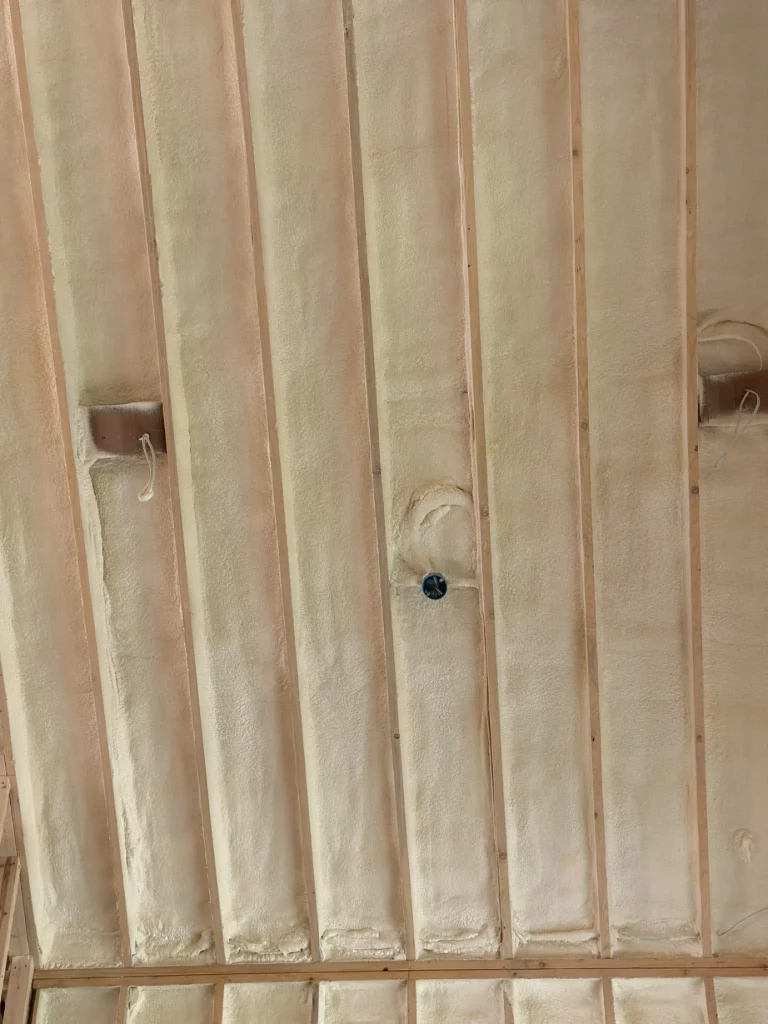
Reference IRC Tables 702.7.1 (walls) and R806.5 (roofs) for the minimum foam thickness required in your specific climate zone. In Climate Zones 5 through 8 and Marine Zone 4, high-density closed-cell foam is the default choice for unvented assemblies.
Use an infrared thermometer to check surface temperatures. Confirm surfaces are clean, dry, and free of frost, oil, or loose material. If ambient conditions are within 5 degrees F of the dew point, delay the installation or introduce dehumidification.
Train all applicators to recognize the visual and tactile signs of off-ratio foam. Check the rise characteristics, cell color, and texture of test samples at regular intervals. If the foam smells persistently chemical or appears crumbly, stop immediately and recalibrate the equipment.
Use aged R-values (LTTR) rather than initial labeled R-values when calculating whether an assembly meets code requirements. Account for thermal drift by specifying slightly more foam than the minimum to provide a performance buffer.
Every spray foam installation that significantly reduces air leakage should be paired with a ventilation strategy. Balanced ventilation with both supply and exhaust airflows ensures moisture removal without creating pressure imbalances that could pull contaminants into the living space.
Conduct post-installation inspections to check for voids, gaps, adhesion failures, and minimum thickness compliance. A blower door test and thermal imaging scan can identify air leakage paths and thermal bridging that visual inspection alone might miss.
Beyond the initial installation quality, several ongoing factors influence how well spray foam performs over the life of the building:
At Lamothe Insulation & Contracting, our team evaluates every project for the right foam type, thickness, and ventilation strategy before any material goes on the wall. We identify and correct the conditions that cause poor spray foam performance so your insulation delivers the energy savings, comfort, and durability you expect.
Request a Quote | Schedule an Insulation Assessment
Call us at (508) 847-0119 or email [email protected] to get started. Proper spray foam installation is not something to leave to chance, and our crew has the experience and training to get it right the first time.
Look for persistent chemical odors that last more than a few days, visible gaps or cracks in the foam, areas where the foam has pulled away from framing or sheathing, and discoloration or crumbly texture. A blower door test or thermal imaging scan performed by a professional can confirm air leakage and voids that are not visible to the naked eye.
Yes, but removal is labor-intensive and costly. Closed-cell foam must be mechanically scraped or ground away from substrates, and open-cell foam can be cut out. In most cases, partial removal and targeted repair of failed areas is more practical than full replacement, provided the underlying cause of the failure has been identified and corrected.
Properly mixed and cured spray foam typically completes off-gassing within 24 to 72 hours. Off-ratio installations can continue off-gassing for weeks or even months. The EPA recommends that building occupants with sensitivities should not re-enter the home until air quality testing confirms chemical levels are within safe limits.
Not always. Closed-cell foam delivers a higher R-value per inch and acts as a vapor retarder, making it the right choice for cold climates, foundations, and unvented roof assemblies. Open-cell foam provides better sound attenuation, is more flexible, and costs less per inch, making it suitable for interior walls, sound control, and warm climate applications where vapor permeability is acceptable.
Spray foam dramatically reduces air leakage, which means the natural ventilation that previously existed through gaps and cracks is now eliminated. Without mechanical ventilation to introduce fresh air and exhaust humid indoor air, moisture from daily activities accumulates. Adding a balanced ventilation system or exhaust fans in bathrooms and kitchens typically resolves the issue.