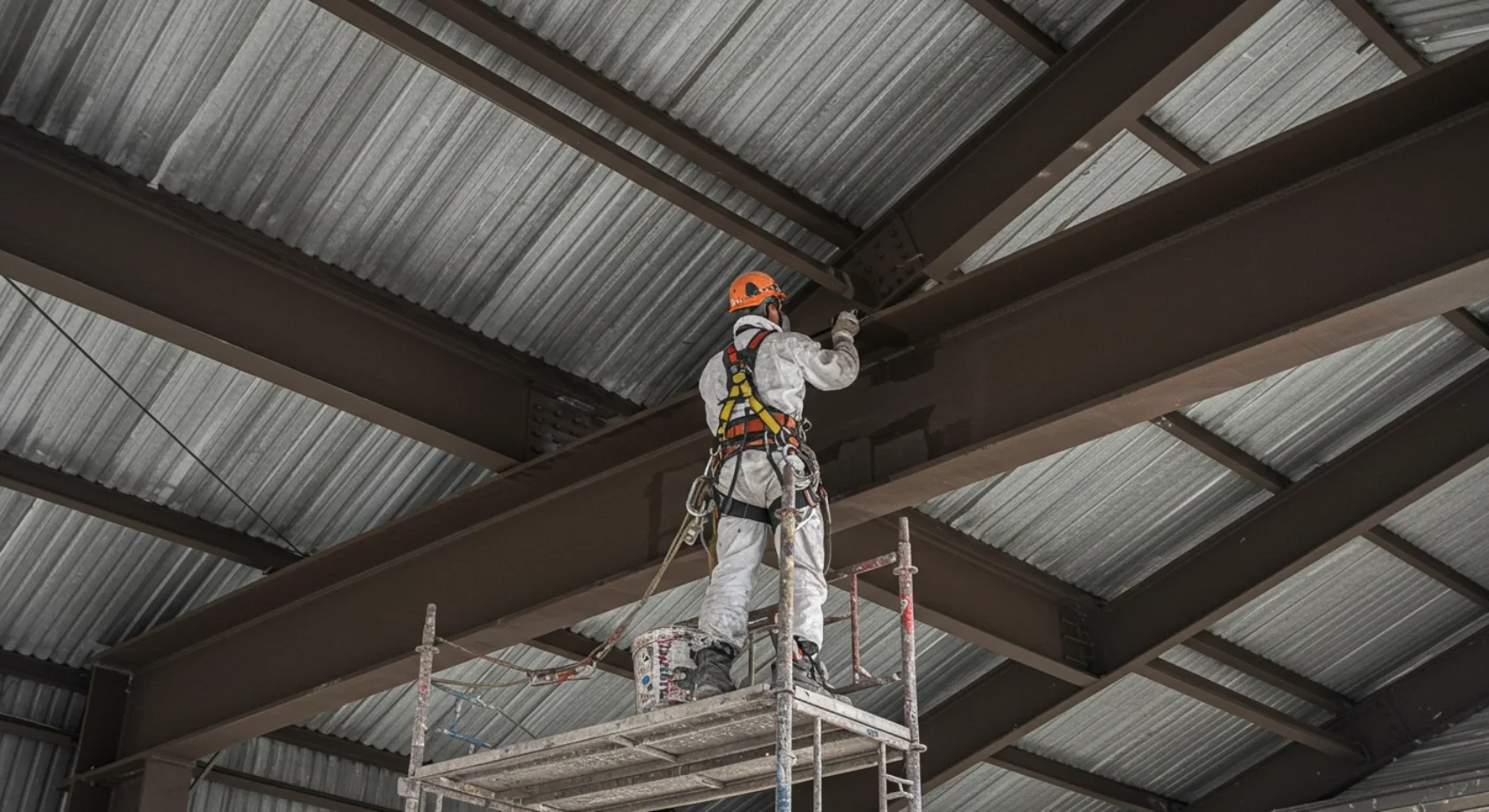
How Is Intumescent Coating Thickness Determined in Spencer, MA?
Determining the required thickness for an intumescent coating is not a matter of guesswork; it is an engineering calculation that…



Closed-cell spray foam creates a continuous air seal by applying liquid polyurethane that expands up to 60 times its original volume, flows into every crack, seam, and joint, and cures into a single rigid layer that insulates, blocks air, and controls moisture in one step. Unlike batts or rigid boards that stop at the edges of framing, foam bonds directly to wood, masonry, and metal, so there is nowhere left for air to slip through. That matters in Worcester, MA, where January temperatures average in the mid-20s and the city collects roughly six feet of snow in a typical winter, because every unsealed inch of envelope drives heat loss, drafts, and ice dams. Below, we explain how the seal actually forms, where it delivers the most value in Worcester homes, how it compares with other air sealing strategies, and how to verify you got what you paid for.
A continuous air seal is an unbroken air barrier that surrounds the entire conditioned space: walls, attic plane, rim joists, and foundation. Insulation slows conducted heat, but it does not stop airflow on its own, and air passes freely through and around porous materials like fiberglass. According to EPA’s ENERGY STAR program, if you added up all the leaks, holes, and gaps in a typical home’s envelope, they would equal leaving a window open every day of the year. In a heating climate like Worcester, that invisible open window runs all winter. Closed-cell foam changes the math because it is the insulation and the air barrier in a single material, so nothing has to be added afterward to close the gaps.
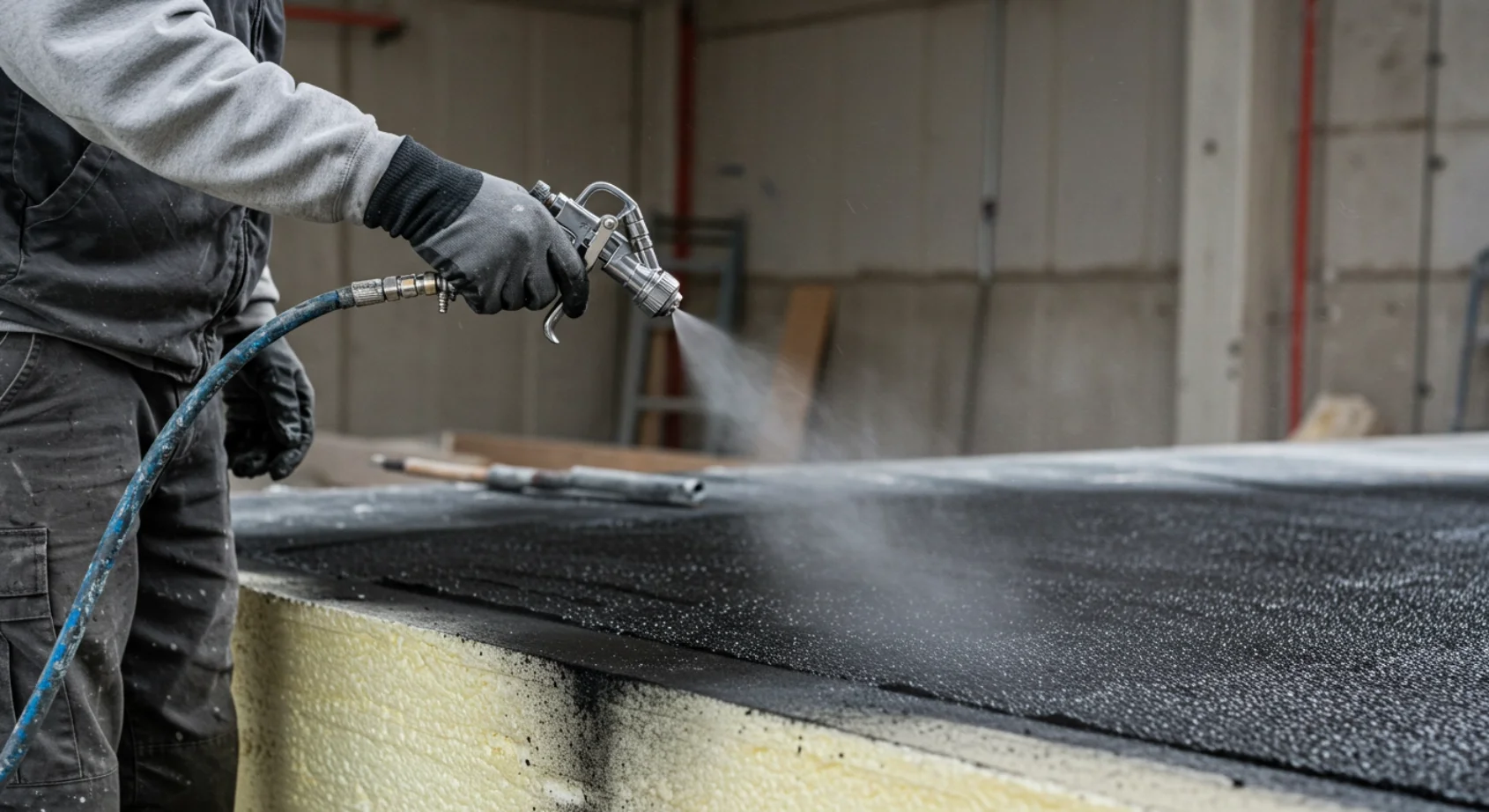
Two liquid ingredients meet at the spray gun and react on contact. The mixture expands up to 30 to 60 times its liquid volume, pushes into cracks, seams, and joints, and bonds to the substrate as it cures within seconds into a rigid plastic, as documented in Wikipedia’s technical overview of spray foam. Because the foam is sprayed, it wraps corners, penetrations, and irregular framing that pre-cut batts and boards can never fully cover. Once cured, each microscopic cell is closed and sealed, which is where closed-cell foam gets its density, its water resistance, and its R-value of greater than 6 per installed inch.
The structure also matters for moisture control. At roughly two inches of thickness, closed-cell foam functions as both an air barrier and a vapor barrier, while open-cell foam needs full wall depth just to stop air and stays permeable to moisture.
| Property | Closed-Cell Foam | Open-Cell Foam |
|---|---|---|
| R-value per inch | Greater than 6.0 | Approximately 3.5 |
| Air barrier | Yes, at any practical thickness | Only at full wall thickness |
| Moisture performance | High moisture barrier, resists water | Higher moisture permeability |
| Structure | Rigid, adds strength | Soft and flexible |
| Best zones | Rim joists, basements, exterior walls, roof decks | Interior sound control, deep open cavities |
Worcester sits in a humid continental climate with cold, windy, snowy winters. Worcester’s climate profile shows January daily means in the mid-20s, roughly 64 to 73 inches of snow in a normal season, and an elevation that makes the city especially prone to nor’easters. That combination drives a strong stack effect: warm indoor air rises and exits high in the structure, pulling cold outside air in through the basement, rim joists, and lower walls, so the harder the heating system works, the faster the leak cycle runs.
The housing stock compounds the problem. The three-decker style originated in Worcester, and many 19th-century homes and former mill buildings still stand with little more than framing and plaster between occupants and the weather. Department of Energy studies cited in Wikipedia’s spray foam overview attribute up to 40% of a home’s energy loss to air infiltration through walls, windows, and doorways. Understanding the benefits and uses of closed-cell spray foam insulation can help homeowners address these vulnerabilities while improving the building envelope. Air sealing also cuts ice dam risk, because heat escaping into the attic is what melts rooftop snow unevenly, and ENERGY STAR specifically lists a lower chance of ice dams among the benefits of a sealed, insulated envelope.
| Area of the Home | Why It Leaks | What Closed-Cell Foam Does |
|---|---|---|
| Rim joists and band boards | Dozens of sill seams and utility penetrations at the foundation line | Seals every hole in one pass while insulating the coldest zone in the house |
| Attic slopes and kneewalls | Wind washing through shallow rafter bays in capes and colonials | Delivers R-6+ per inch where cavity depth is limited |
| Basement and crawlspace walls | Ground moisture meeting cold foundation surfaces | Provides air, vapor, and water resistance in one layer |
| Additions and cantilevers | Framed overhangs exposed to weather on five sides | Encapsulates cavities that batts leave drafty |
| Strategy | Air Sealing | Thermal Value | Moisture Control | Best For |
|---|---|---|---|---|
| Closed-cell spray foam | Continuous, seals as it sprays | R-6+ per inch | Air and vapor barrier in one | Rim joists, basements, walls, roof decks |
| Open-cell spray foam | Good at full depth | About R-3.5 per inch | Permeable | Sound control, deep attic cavities |
| Fiberglass batts | None on their own | R-3 to R-4 per inch | None | Budget fills paired with a separate air barrier |
| Blown cellulose | Slows but does not stop airflow | About R-3.5 per inch | Absorbs moisture | Dense-packed wall retrofits |
| Caulk and weatherstripping | Spot sealing only | None | None | DIY gaps at windows, doors, and trim |
The EPA estimates homeowners can save up to 10% on annual energy bills, and an average of 15% on heating and cooling costs alone, by sealing leaks and adding insulation where it counts. The strategy that captures the fullest share of that number is the one that leaves no unsealed surface, which is exactly what closed-cell foam does by design. Foam seals and insulates in the same pass, per the industry’s SPF basics guide, forming a continuous barrier over walls, corners, and contoured surfaces.

Our team starts with a whole-home assessment to find where air actually enters, prioritizing the rim joist, attic plane, and foundation zones that drive stack effect. From there, we write a clear scope: which zones get closed-cell foam in Worcester, MA, the target thickness, and where a complementary material makes more sense than foam. During application, our crew follows the safety practices the industry requires, keeping occupants out of the work area during spraying and for the reentry period specified for the product, with proper ventilation and protective equipment in use. We finish with verification, checking full coverage visually and, where requested, using blower door testing so the airtightness result is proven with numbers rather than promises.
At Lamothe Insulation and Contracting, we build air seals the way they should be built: assessed first, scoped honestly, applied to full specified thickness, and verified when the crew leaves. Call us at (508) 847-0119 or email [email protected] to talk through your home’s leak zones with our team before the next nor’easter tests your envelope.
Schedule an Air Seal Assessment
Yes. At roughly two inches of installed thickness, closed-cell foam functions as both, which is why it suits rim joists, basements, and exterior walls in cold, damp climates.
Rim joist and attic projects usually wrap in a day, while whole-home scopes run two to three days, plus the reentry period specified for the product after spraying ends.
Yes. The highest-impact zones, the rim joist, basement, crawlspace, and attic plane, are accessible in nearly every older home, and closed-cell foam reaches them without demolition.
No, as long as ventilation is planned alongside the tightening. Our team addresses this during the assessment so fresh-air needs are met after the seal is complete.
Yes. By stopping heat from leaking into the attic, foam addresses the melt-freeze cycle that forms ice dams, a benefit ENERGY STAR ties directly to sealing and insulating in snowy climates.