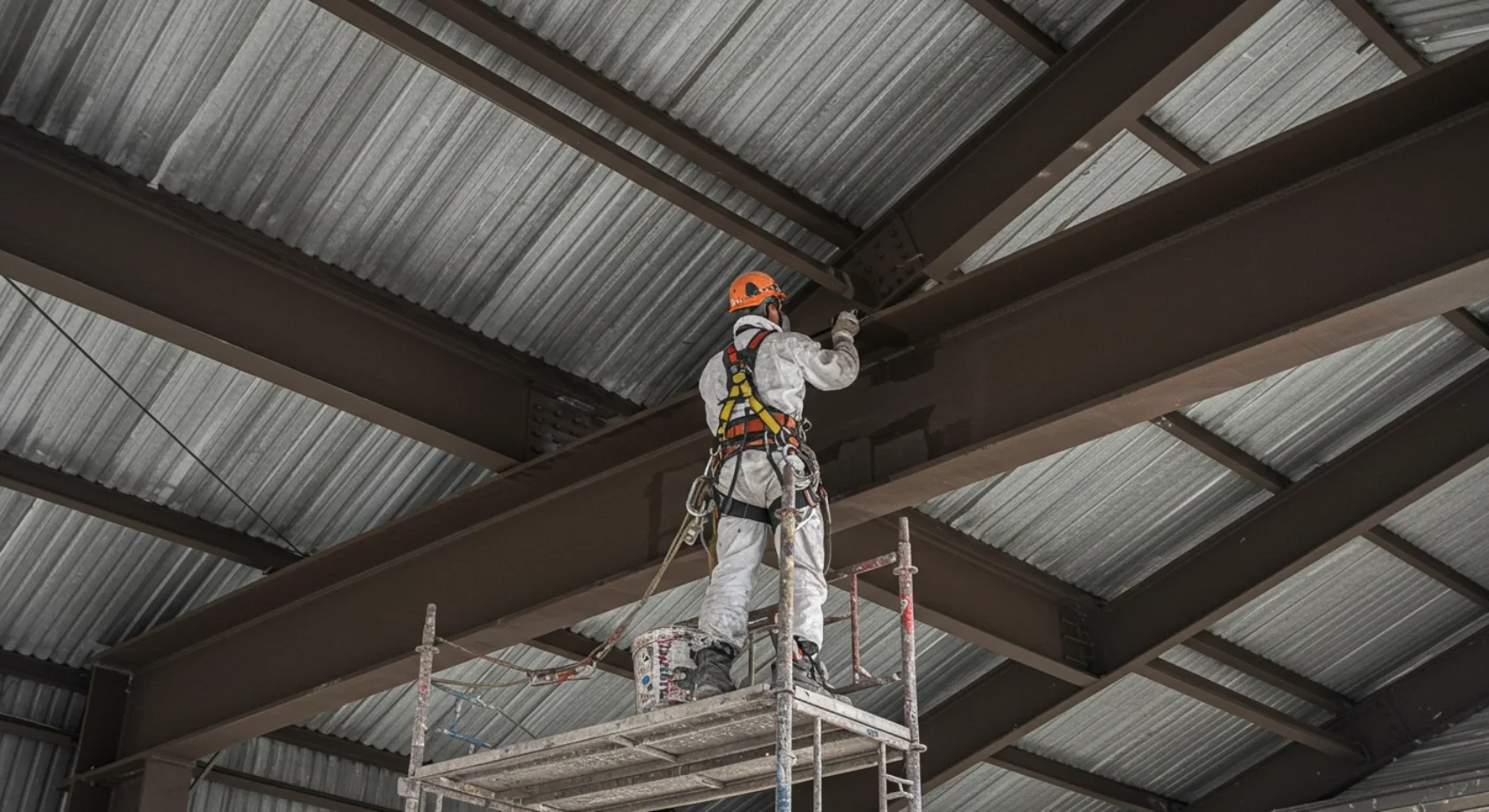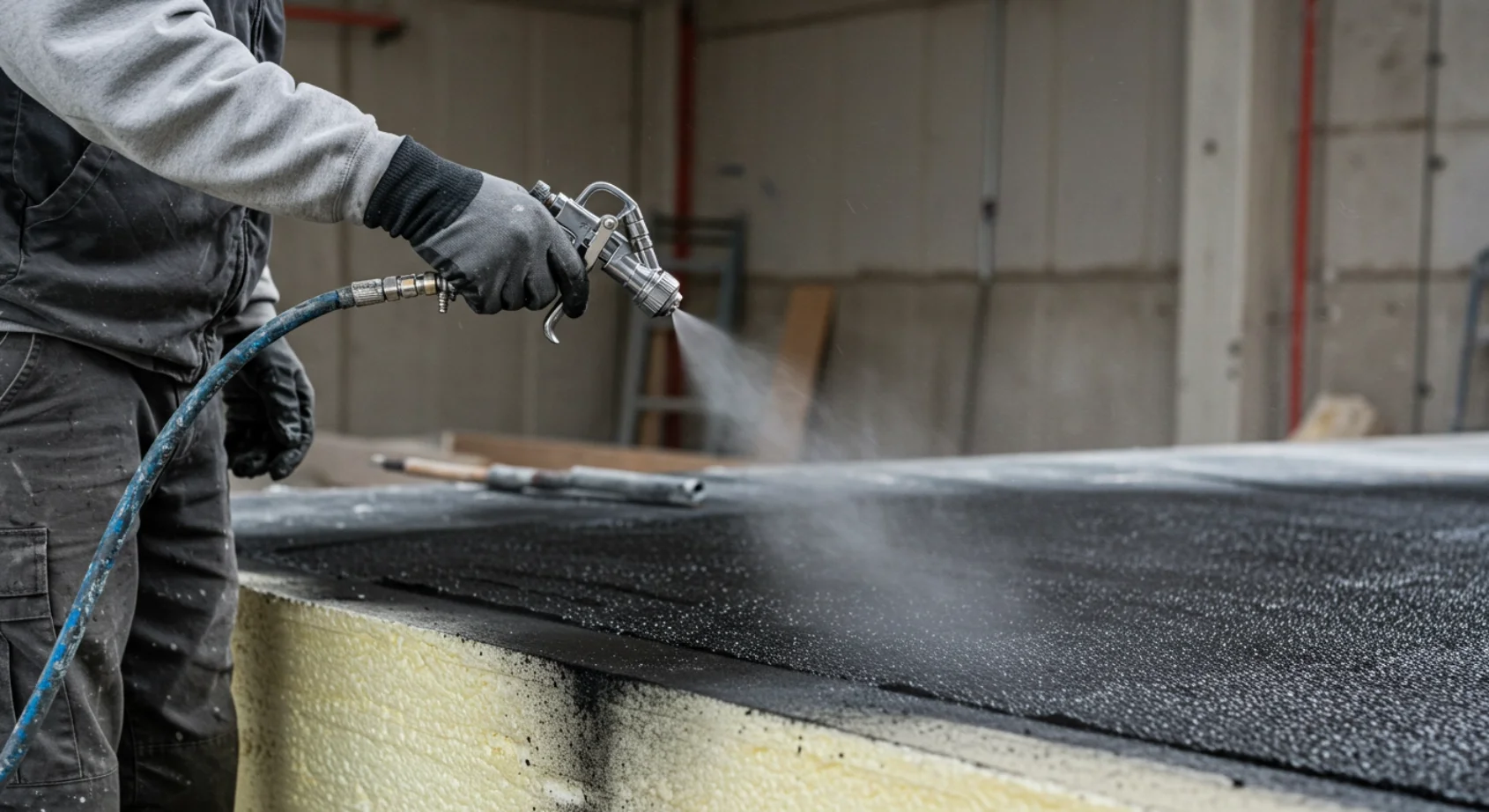
How Is Intumescent Coating Thickness Determined in Spencer, MA?
Determining the required thickness for an intumescent coating is not a matter of guesswork; it is an engineering calculation that…


Walk down the hallway of an older house on a January morning and you can feel the problem before you can name it. One bedroom runs cold. The floor above the garage never warms up. The basement smells damp, and in summer the upstairs turns muggy no matter how long the AC runs. In most homes we inspect, those symptoms trace back to the same two culprits: insulation that blocks heat but not air, and a leaky building envelope that lets outside air (and moisture) push its way in. Closed-cell spray foam insulation attacks both problems at once, and that’s why it has become the material we reach for when a home needs real, measurable performance rather than a patch.
This guide is the reference we wish every homeowner had before signing a contract. It comes out of years on job sites, spraying foam in basements, crawl spaces, cathedral ceilings, and walls, and learning the hard lessons along the way: what a good substrate looks like, what off-ratio foam smells like, and why the details on spray day matter as much as the material itself.
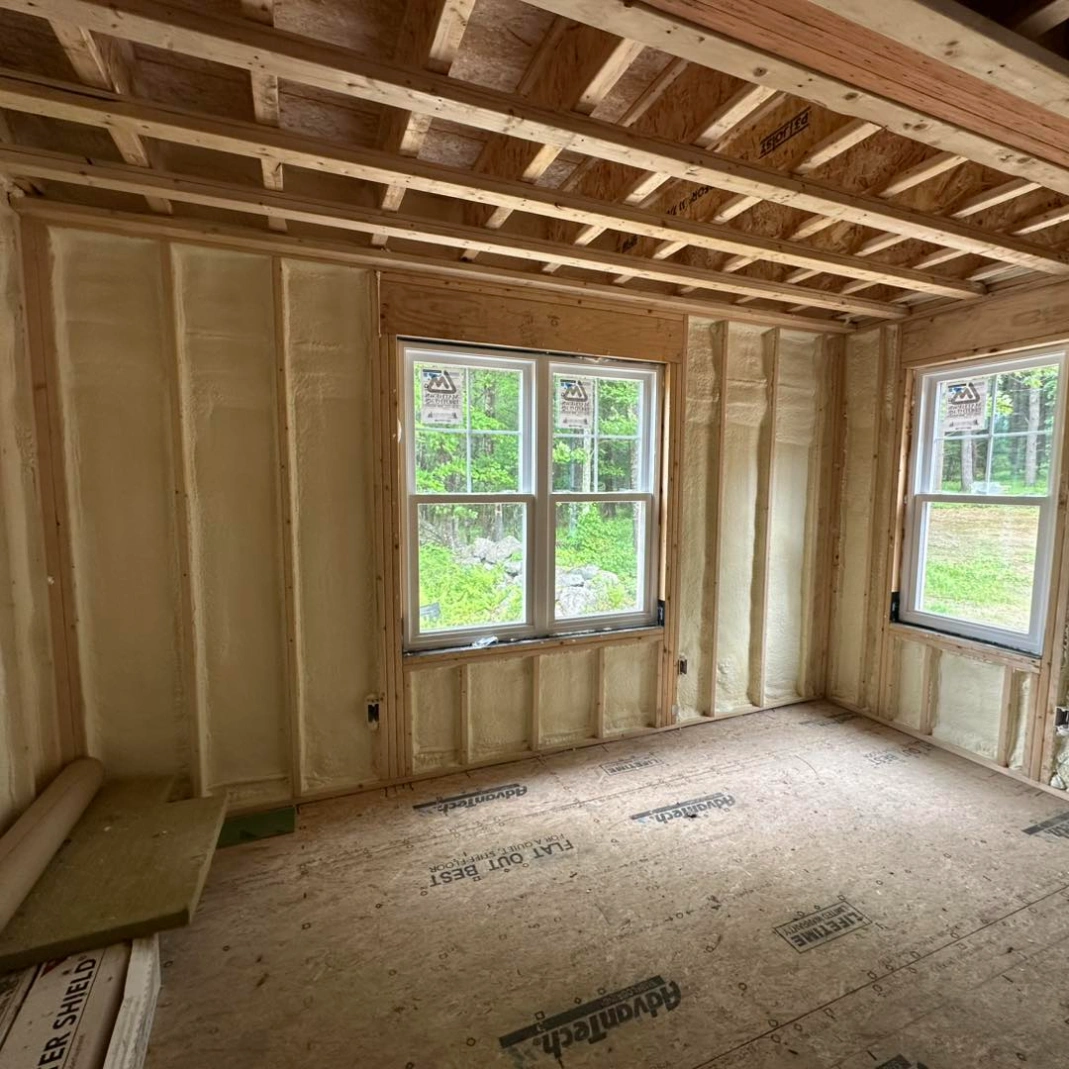
Closed-cell spray foam insulation is a two-component polyurethane product that’s mixed at the spray gun and expands on contact into a rigid, high-density insulating layer. One tank (the A-side) carries isocyanate, the reactive compound. The other (the B-side) carries a polyol blend with blowing agents, catalysts, and flame retardants. When the two are heated, pressurized, and combined at the gun, the liquid froths and expands many times its original volume within seconds.
The name comes from the structure of the cured foam. Each tiny bubble, or cell, stays sealed and holds a low-conductivity gas inside. Those sealed cells are what set it apart from open-cell foam, whose bubbles are intentionally broken, leaving a soft, sponge-like material. As the Department of Energy explains in its Insulation Fact Sheet, open-cell foam lets water vapor pass through far more easily, and it delivers a lower R-value for a given thickness than closed-cell foam, which is why closed-cell is the choice when space is tight.
A few numbers help frame the difference:
That last point deserves emphasis, because it changes how you think about the product. Batts and blown-in fibers insulate the cavity they sit in. Closed-cell spray foam becomes part of the wall or roof, bonding to wood, concrete, and steel as it cures.
Most insulation discussions obsess over R-value, the measure of resistance to heat flow through a material. Closed-cell spray foam r-value matters, but it only tells you how well insulation slows heat that’s touching it. It says nothing about air that blows through and around it.
Think of it this way: insulation is a sweater. On a cold, still day, a sweater works great. On a windy day, you need a windbreaker over it or the wind cuts right through. A fiberglass batt is a sweater. Closed-cell spray foam is the sweater and the windbreaker in one product.
Air leakage is not a small effect. Heating and cooling account for 50 to 70 percent of the energy used in the average American home, and inadequate insulation and air leakage are the leading causes of energy waste, according to the DOE Insulation Fact Sheet. Warm air rises and escapes through the top of the house, pulling cold outside air in through the basement and rim joists to replace it. This stack effect runs all winter, and the leaks it exploits are rarely the ones you can see. They hide at wall-top plates, behind bathtub surrounds, around recessed lights, and at plumbing penetrations.
The savings from fixing this are well documented. The EPA estimates that homeowners who air seal and add insulation in attics, floors over crawl spaces, and basement rim joists save an average of 15 percent on heating and cooling costs, or 11 percent on total energy costs, based on energy modeling described in ENERGY STAR’s methodology report. In the coldest climate zones, modeled savings on heating and cooling reach 18 to 19 percent. And those figures assume only a 25 percent reduction in air infiltration. Foam-sealed assemblies routinely go further than that.
Expert Tip: When you compare quotes, ask each contractor what the proposed system does about air leakage, not just R-value. A wall at R-13 that’s foam-sealed and airtight will outperform a leaky R-19 wall in most real-world conditions.
Each benefit below traces back to the same sealed-cell, high-density structure. Here’s the full picture.
Closed-cell foam packs roughly twice the R-value per inch of fiberglass batts or blown-in cellulose. In a 2×4 wall, that’s the difference between a modest R-13 cavity fill and something in the R-21 to R-26 range, with no exterior surgery. The same math matters enormously in shallow assemblies: garage ceilings, knee walls, and the short rafter bays in Cape Cod-style roofs, where there simply isn’t depth for two feet of fluffy insulation.
Here’s how the common materials compare:
| Insulation Type | Typical R-Value per Inch | Seals Air Leaks? | Resists Water? | Adds Rigidity? |
|---|---|---|---|---|
| Closed-cell spray foam | R-6.0 to R-7.0 | Yes, completely | Yes | Yes |
| Open-cell spray foam | R-3.5 to R-3.8 | Yes, completely | No, absorbs vapor | No |
| Fiberglass batts | R-2.9 to R-3.8 | No | No | No |
| Blown-in cellulose | R-3.2 to R-3.7 | No | No | No |
Values are typical product ranges; always confirm the labeled R-value for the specific material being installed.
Because the cells are sealed and the foam is dense, closed-cell foam dramatically slows water vapor movement. Two inches is typically enough to function as a low-permeance vapor retarder in most assemblies. In a humid basement or a crawlspace, that means moist air hitting a cool foundation wall gets stopped before it can condense. Mold needs moisture and a food source; closed-cell foam denies it the moisture and isn’t itself a food source.
Water is where the closed-cell difference becomes dramatic. Fiberglass batts that get soaked sag, mat, and usually need to be torn out. Open-cell foam holds water like a sponge. Closed-cell foam sheds it. FEMA’s Technical Bulletin 2 on flood-resistant materials defines a flood-resistant material as one that can survive direct, prolonged contact with floodwater, at least 72 hours of it, without damage beyond cosmetic repair, and only the two highest material classes are permitted below a building’s base flood elevation. The closed-cell structure is why spray polyurethane foam is the insulation we specify when those flood-zone rules apply, while open-cell foam and any fibrous insulation simply don’t qualify.
Closed-cell foam adds racking strength to walls and stiffens roof decks. It also doesn’t settle, sag, or slough off vertical surfaces over time. Batts can slide down or leave gaps as a house moves through its seasons; foam stays where it was sprayed. Installed correctly, it lasts the life of the building.
When ducts run through attics or crawl spaces, they leak energy into unconditioned air. The DOE notes that leaky ductwork in a traditional vented attic can waste up to a quarter of a home’s heating and cooling energy, which is one reason unvented, foam-sealed rooflines have become popular. Bringing ducts inside the conditioned envelope with closed-cell foam on the roof deck is often the single biggest comfort upgrade an attic-dominated house can get.
Key Takeaways
After enough jobs, you learn where this material shines and where it’s overkill. These are the applications where we see it deliver the most.
The joint where the house framing sits on the foundation is one of the leakiest spots in any home, and it’s full of awkward gaps around sill plates, bolts, and plumbing penetrations. Closed-cell foam fills every void in a single pass, insulates and seals at once, and stands up to the occasional damp conditions found near concrete. For a targeted upgrade with an outsized comfort payoff, this is usually first on the list. [Link to: Detailed Guide on Rim Joist Insulation]
Spraying closed-cell foam directly on foundation walls turns a vented, humid crawlspace into a sealed, semi-conditioned space. That keeps the floors above warm, protects pipes from freezing, and stops ground moisture from wicking into the house. Encapsulation done this way also keeps rodents and insects from nesting in exposed fiberglass. [Link to: Detailed Guide on Crawl Space Encapsulation]
For rooms with vaulted ceilings, or any house where ductwork lives in the attic, spraying closed-cell foam on the underside of the roof sheathing creates an unvented, conditioned roofline. The foam’s high R-per-inch is essential here because rafter bays are shallow, and its vapor-control properties are what let the assembly be built without ventilation beneath the sheathing. [Link to: Detailed Guide on Attic Insulation Options]
In standard walls, closed-cell foam delivers code-level R-values in cavities too shallow for anything else to hit the target. In steel-framed buildings, where metal studs conduct heat so aggressively that cavity insulation alone underperforms, foam bonded to the framing and sheathing helps blunt the thermal short-circuit. [Link to: Detailed Guide on Commercial and Agricultural Spray Foam Applications]
Condensation is the enemy in metal structures. Closed-cell foam bonds to the steel, stops the warm moist inside air from reaching the cold panel surface, and eliminates the dripping that ruins equipment and stored feed. It also adds stiffness to the panels themselves.
Because it’s rigid, buoyant, and waterproof, closed-cell foam also shows up in boat flotation, dock floats, and sound stages built on irregular substrates. If a project needs a material that insulates and adds volume and structure at once, this is the tool.
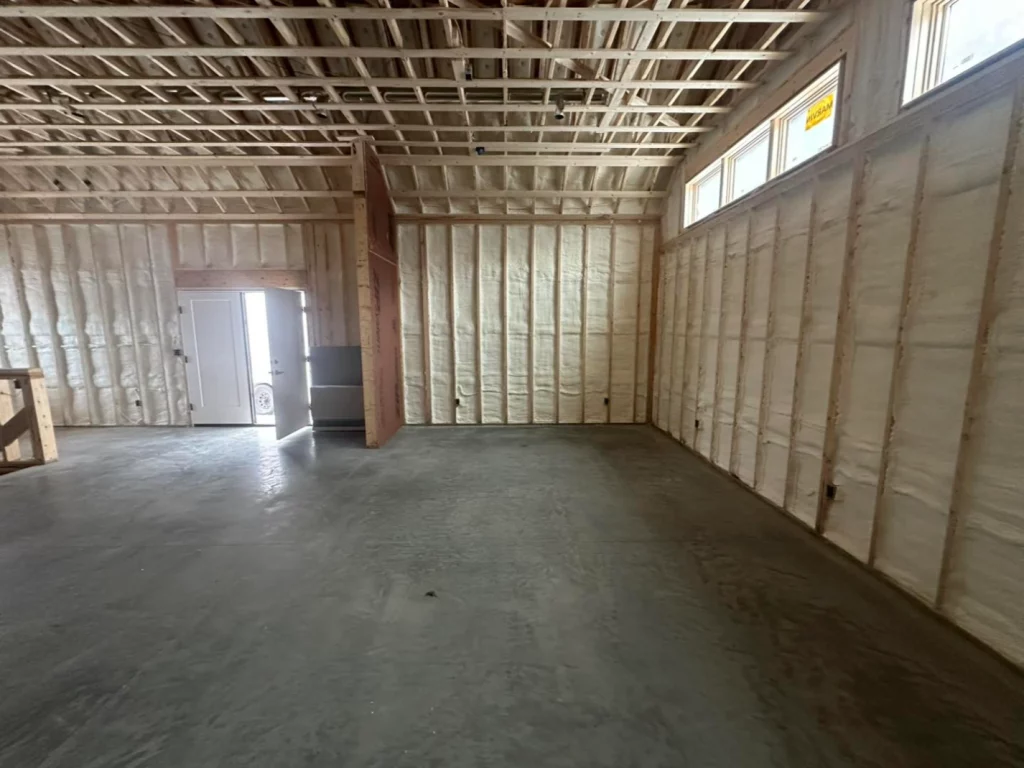
This is the question we answer most often, and the honest answer is that both are excellent materials aimed at different problems. Closed-cell wins on R-value per inch, moisture resistance, rigidity, and strength. Open-cell costs less per inch of depth, fills deep cavities completely, and absorbs sound better, which makes it popular for interior walls and deep attic spaces in dry, above-grade assemblies. The DOE fact sheet draws the same basic line: open-cell foam passes vapor more readily and offers lower R-value per inch, while closed-cell provides greater R where space is limited.
| Factor | Closed-Cell | Open-Cell |
|---|---|---|
| R-value per inch | R-6.0 to R-7.0 | R-3.5 to R-3.8 |
| Density | ~1.5-2.0 lb/cu ft | ~0.5 lb/cu ft |
| Vapor control | Low permeance (retards vapor) | High permeance (vapor passes) |
| Water contact | Sheds it | Absorbs and holds it |
| Rigidity | Rigid, adds strength | Soft, flexible |
| Sound dampening | Moderate | Excellent |
| Best for | Below-grade, flood zones, shallow cavities, roofs, metal | Deep walls and attics, sound control, above-grade wood framing |
One popular middle path is a hybrid: a couple of inches of closed-cell foam against the sheathing for air and vapor control, then blown-in or batt insulation on top to reach the target R-value at a friendlier installed price. Done right, this “flash and fill” approach gets most of the foam’s benefit where it counts.
Expert Tip: Match the foam to the assembly, not the brochure. In a cold climate, putting vapor-open insulation against the exterior sheathing of a wall and sealing the interior with closed-cell foam can shift where moisture condenses. The right call depends on the climate zone, sheathing type, and which side of the wall is cold. That’s a question for an experienced installer, not a product datasheet.
Spray polyurethane foam is a manufactured-on-site chemical reaction, which means installation quality isn’t a detail; it’s the whole ballgame. Here’s how a professional job unfolds.
We verify what’s behind the surfaces: active leaks, degraded wiring, and anything that can’t contact foam. One hard rule comes straight from fire safety guidance in the DOE Insulation Fact Sheet: the National Electric Code forbids installing foam-in-place insulation around knob-and-tube wiring, so any pre-1940 wiring must be evaluated and addressed first. Occupants, pets, and food are cleared from the work zone, and adjacent areas get masked and sealed with plastic.
Foam bonds to surfaces, and chemistry punishes shortcuts. The substrate must be dry, clean, and within the temperature range on the product data sheet. Spraying onto damp wood or frosty concrete is how you get foam that peels away in sheets weeks later. On borderline days, we check the substrate with a moisture meter and adjust or reschedule.
A rig pulls the two components from drums, heats them, and pumps them through a heated hose to the gun, where they mix and react. The applicator builds thickness in lifts, typically passing over the surface in layers, watching the rise, the color, and the texture of the foam in real time. Cured closed-cell foam should look even and slightly textured, like an orange peel.
After curing, foam in framed walls gets shaved flush with the studs so drywall sits flat. The crew then inspects the full application: every square foot should be uniform, bonded, and free of voids, cracks, or shrinkage away from framing.
Plastic foam insulation must be protected from fire, and the standard remedy is a thermal or ignition barrier, most commonly half-inch gypsum board, as the DOE fact sheet notes. In some applications, intumescent coatings rated for foam can substitute where drywall isn’t practical, such as in metal buildings and crawlspaces.
Because the work involves reactive chemicals, the area stays off-limits during spraying and until the foam has cured and the space has been ventilated, following the product label’s occupancy interval. A properly mixed and cured foam is inert once it’s done off-gassing; problems come from foam that never reacted correctly in the first place, which is why the next section matters.
Expert Tip: Ask any installer two questions before signing: What product data sheet governs substrate temperature and lift thickness for this job? And who, by name, will be running the gun? Foam chemistry isn’t forgiving of guesswork, and experienced applicators are worth the difference.
We’ve repaired and removed enough bad foam to know exactly how jobs go wrong. Every failure below has the same root cause: the chemical reaction didn’t happen as designed, or the assembly was designed wrong from the start.
If you’re buying a home with existing spray foam, most of these issues are visible to a trained eye: color, texture, adhesion, and odors tell a story.
Key Takeaways
The case for closed-cell foam isn’t a feeling of warmth, it’s numbers you can check before and after.
Remember the EPA figures cited earlier: an average 15 percent cut in heating and cooling costs from air sealing and insulation upgrades, rising to nearly 19 percent in the coldest zones. Foam projects that seal the biggest leak paths push toward the top of those ranges. Add the avoided costs you never see on a bill, like ice dams that stop tearing up roof edges, pipes that stop freezing, and HVAC that no longer runs flat out to keep up, and the case gets stronger still. And unlike every fibrous option, foam doesn’t settle or degrade, so year fifteen performs like year one.
You now have the full picture: what closed-cell spray foam is, why it outperforms on R-value per inch while also solving air leakage, vapor, moisture, and even flood exposure, where it earns its place in a home, and what a correctly executed installation looks like from prep through inspection. You also know the failure modes and the questions that separate experienced installers from hopeful ones.
Use this guide as a checklist when you evaluate your own building. Walk the basement and look at the rim joist. Note which rooms never hold temperature. Ask about blower door testing so your results are measured, not promised. And when you talk to an installer, bring the hard questions: substrate moisture, lift thickness, ignition barriers, and re-entry intervals. Good crews welcome them.
If you’re weighing closed-cell spray foam against other options, or you want an honest assessment of your home before you commit, talk to us. Lamothe Insulation and Contracting has sprayed foam in basements, crawl spaces, attics, and walls for years, and we’ll tell you plainly where closed-cell makes sense and where it doesn’t. Call (508) 847-0119 or email [email protected] to schedule a free consultation. The walkthrough costs nothing, and the advice is yours to keep.
Indefinitely, in practical terms. Once cured, it’s inert plastic bonded to the structure. It doesn’t settle, sag, absorb moisture, or provide food for pests, so it performs the same decades later as on install day.
Not in the work zone. The area must be vacated during spraying and until the foam is cured and ventilated per the product label, typically a day or so for occupied homes. After proper cure and ventilation, the space is safe for normal occupancy.
No, when it’s matched to the right assembly. Closed-cell foam is a vapor retarder, so it belongs on the side of the assembly where vapor control is needed for your climate. Failures come from poor design or sloppy installation, not from the material itself.
Standard modern wiring is fine; foam is simply sprayed around boxes and cables like any insulation. The exception is old knob-and-tube wiring, which the National Electric Code prohibits insulating with foam-in-place products and which must be evaluated first.
It depends on the target R-value and the assembly. Two inches (roughly R-12 to R-14) is a common minimum where air sealing and vapor control are the goals, with additional passes added to hit the R-value the design calls for.
Yes. Closed-cell foam bonds framing members together and adds racking strength to walls and stiffness to roof decks and metal panels, a benefit no batt or blown-in product provides.