How to Address Uneven Insulation Coverage With Open-Cell Spray Foam in Worcester, MA
Fixing uneven insulation coverage with open-cell spray foam in Worcester, MA starts with diagnosis, not with more foam. Our team…


Yes, open-cell spray foam is air-impermeable when installed at the proper thickness, typically between 3.0 and 5.5 inches depending on the specific product. It meets the International Residential Code definition of an air-impermeable insulation material, which requires an air permeance of 0.02 L/s-m² or less at 75 Pa pressure differential when tested per ASTM E2178 or E283. However, open-cell spray foam is vapor-permeable, meaning it allows water vapor to pass through while blocking bulk air movement. This distinction between air permeability and vapor permeability is one of the most commonly misunderstood aspects of spray foam insulation, and getting it wrong can lead to moisture problems, code violations, and wasted investment. Whether open-cell spray foam is the right choice depends on your climate zone, the specific application within the building envelope, and whether additional vapor control measures are needed.
This is the single most important distinction for property owners to understand. Air permeability refers to how easily air moves through a material under pressure. Vapor permeability refers to how easily water vapor diffuses through a material. Open-cell spray foam performs very differently on these two measures, and confusing the two leads to poor insulation decisions and potentially costly building envelope failures.
According to the U.S. Department of Energy’s Building America research, open-cell spray foam has an air permeance of just 0.0049 L/s-m² at 75 Pa when installed at 5.25 inches, which is well below the 0.02 L/s-m² code threshold for an air-impermeable material. By comparison, its vapor permeance at 5 inches ranges from 5 to 10 perms. A vapor retarder, by definition, has a perm rating of 1.0 or less.
This means open-cell spray foam blocks air movement effectively but allows moisture vapor to pass through freely. In many building assemblies, this is actually an advantage. It means the wall or roof assembly can dry in both directions, reducing the risk of trapped moisture. But in cold climates where warm interior air carries significant moisture, that vapor permeability means an additional vapor retarder may be needed on the warm side of the insulation to prevent condensation within the assembly.
| Property | Open-Cell Spray Foam | Closed-Cell Spray Foam |
|---|---|---|
| Air Impermeable At | 3.0 to 5.5 inches | 1.0 to 1.5 inches |
| Air Permeance | 0.0049 L/s-m² at 75 Pa (5.25″) | 0.000025 L/s-m² at 75 Pa (5.25″) |
| Vapor Permeance | 5 to 10 perms (5″ thick) | Less than 1 perm (2″ thick) |
| Vapor Retarder Class | Class III (vapor semi-permeable) | Class II (vapor semi-impermeable) |
| Absorbs Liquid Water | Yes, up to 1/3 by volume | No, hydrophobic |
| R-Value Per Inch | R-3.6 | R-6.0 to R-6.5 |
| Density | 0.5 lb/cf | 2.0 lb/cf |
The International Residential Code (IRC) and International Energy Conservation Code (IECC) both define air-impermeable insulation using the same benchmark: air permeance of 0.02 L/s-m² or less at a 75 Pa pressure differential when tested per ASTM E2178 or ASTM E283. Joseph Lstiburek of Building Science Corporation, who helped develop this definition, has noted that the 0.02 threshold was based on testing drywall, which naturally falls just under that value and serves as a practical baseline.
The Building America Solution Center explains that building codes treat air-impermeable insulation differently from air-permeable insulation in several key applications. For unvented attic assemblies, air-impermeable insulation applied in direct contact with the underside of the structural roof sheathing is permitted across all climate zones. Air-permeable insulation, on the other hand, is restricted to climate zones 1 through 3 and requires additional measures such as rigid foam board above the roof deck or vapor diffusion ports.
For property owners, this means that if open-cell spray foam is installed at the manufacturer’s specified minimum thickness for their product, it meets the code definition of air-impermeable insulation. But the same foam does NOT meet the code’s vapor retarder requirements for cold-climate roof assemblies without additional measures.
Open-cell spray foam offers several advantages that make it the preferred option in specific scenarios. According to the Building Science Corporation’s Residential Spray Foam Guide, both open-cell and closed-cell spray foams work effectively in most wall applications, and open-cell is considered the preferred option for cold-climate frame wall cavities.
Open-cell spray foam expands up to 150 times its original liquid volume, compared to 35 to 50 times for closed-cell. This higher expansion ratio means it fills gaps, cracks, and voids more completely with less raw material, creating a near-perfect air seal in wall cavities, band joists, and ceiling penetrations. Its flexibility also gives it a mechanical advantage over rigid closed-cell foam: building science testing has shown that open-cell foam maintains consistent air tightness across a wide temperature range, while the rigidity of closed-cell foam can lead to increased leakage at framing joints as temperatures shift and materials expand and contract at different rates.
The vapor permeability of open-cell foam is a real advantage in mixed-humid and warm climates. It allows wall assemblies to dry outward, prevents trapped moisture, and works compatibly with wood framing, which also absorbs and releases moisture. In hot-humid climates specifically, interior vapor retarders must be avoided when using open-cell foam, since the vapor drive is from exterior to interior and an interior retarder could trap moisture within the wall cavity.
There are several applications where open-cell spray foam is either not recommended or requires specific additional measures. In IECC Climate Zones 5 and higher, the DOE Building America program advises that air-impermeable insulation in unvented attic assemblies must also function as a Class II vapor retarder. Open-cell spray foam does not meet this requirement on its own, meaning either closed-cell foam should be used or an additional Class II vapor retarder coating must be applied in direct contact with the underside of the insulation.
Below-grade applications are another area of concern. The DOE’s research states that open-cell spray foam should never be used under basement floor slabs and is not recommended for exterior basement foundation applications. Its ability to absorb and hold liquid water, while beneficial in above-grade wall assemblies for moisture buffering, becomes a liability when groundwater or flooding is a factor.
Hot-humid climates with brick veneer also present risks. Solar-driven moisture from wet brick can be pushed into the frame cavity through the foam, potentially overwhelming the assembly’s drying capacity. In these scenarios, closed-cell foam provides a redundant moisture control layer that open-cell cannot match.
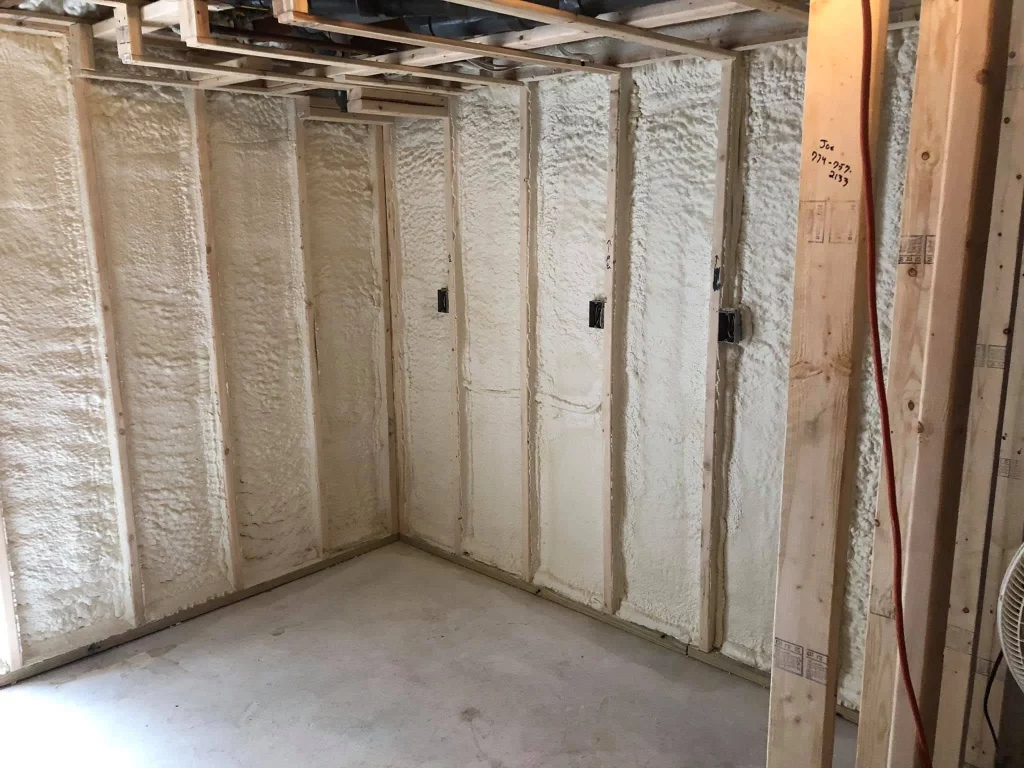
The following guidance is adapted from the DOE’s Building America spray foam guide and Building Science Corporation recommendations:
| Application | Cold Climates (Zones 5-8) | Mixed/Humid (Zones 3-4) | Hot-Dry (Zones 2-3) |
|---|---|---|---|
| Frame Wall Cavities | Preferred (with interior vapor retarder) | Acceptable | Preferred |
| Roof Rafters / Unvented Attic | Acceptable with vapor retarder coating | Acceptable | Acceptable |
| Band Joists / Mudsills | Acceptable (closed-cell preferred) | Acceptable | Acceptable |
| Cantilevered Framing | Acceptable (with vapor retarder below) | Acceptable | Acceptable |
| Below-Grade / Foundations | Not acceptable | Not acceptable | Not acceptable |
| HVAC Duct Insulation | Not acceptable | Not acceptable | Not acceptable |
| Behind Brick Veneer | Not acceptable | Not acceptable | Not acceptable |
Choosing the right installer matters as much as choosing the right material. An experienced spray foam contractor should be able to explain the air permeability versus vapor permeability distinction without hesitation. They should discuss your climate zone, the specific assembly being insulated, and whether additional vapor retarders are needed. If a contractor tells you open-cell spray foam is just as good as closed-cell in every situation, that is a red flag.
A qualified installer will reference manufacturer Evaluation Service Reports (ICC-ES) that confirm the minimum thickness their specific product requires to qualify as air-impermeable. They will also discuss the importance of proper substrate preparation, consistent spray thickness, and code-required thermal or ignition barriers. Our team evaluates every project individually, considering climate zone, assembly type, and building science principles to recommend the insulation approach that protects your property long-term.
At Lamothe Insulation and Contracting, we help property owners make informed decisions about spray foam insulation based on building science, not guesswork. Our team assesses your building envelope, climate zone requirements, and project goals to recommend the right insulation system and thickness for lasting performance and energy efficiency. Whether you are building new, retrofitting an existing home, or addressing moisture concerns, we provide expert guidance from start to finish.
Request a Free Quote | Schedule an Insulation Assessment
Call us at (508) 847-0119 or email [email protected] to get started.
No. Open-cell spray foam is vapor-permeable, rated at approximately 5 to 10 perms at typical installed thicknesses. It allows water vapor to pass through while blocking air movement.
Most open-cell spray foam products qualify as air-impermeable at 3.5 to 5.5 inches, depending on the manufacturer’s specific testing data and ICC-ES evaluation report.
Yes, it can be used in cold-climate wall cavities, but it typically requires an interior vapor retarder such as vapor-retarder primer or latex paint to control condensation.
Yes, open-cell spray foam can absorb and hold liquid water, up to approximately one-third of its volume by some manufacturer estimates. It will dry out over time given adequate drying conditions.
Both qualify as air-impermeable at their respective minimum thicknesses. Closed-cell achieves this at 1 to 1.5 inches, while open-cell requires 3 to 5.5 inches. Real-world air leakage differences between the two are minimal.