How to Address Uneven Insulation Coverage With Open-Cell Spray Foam in Worcester, MA
Fixing uneven insulation coverage with open-cell spray foam in Worcester, MA starts with diagnosis, not with more foam. Our team…


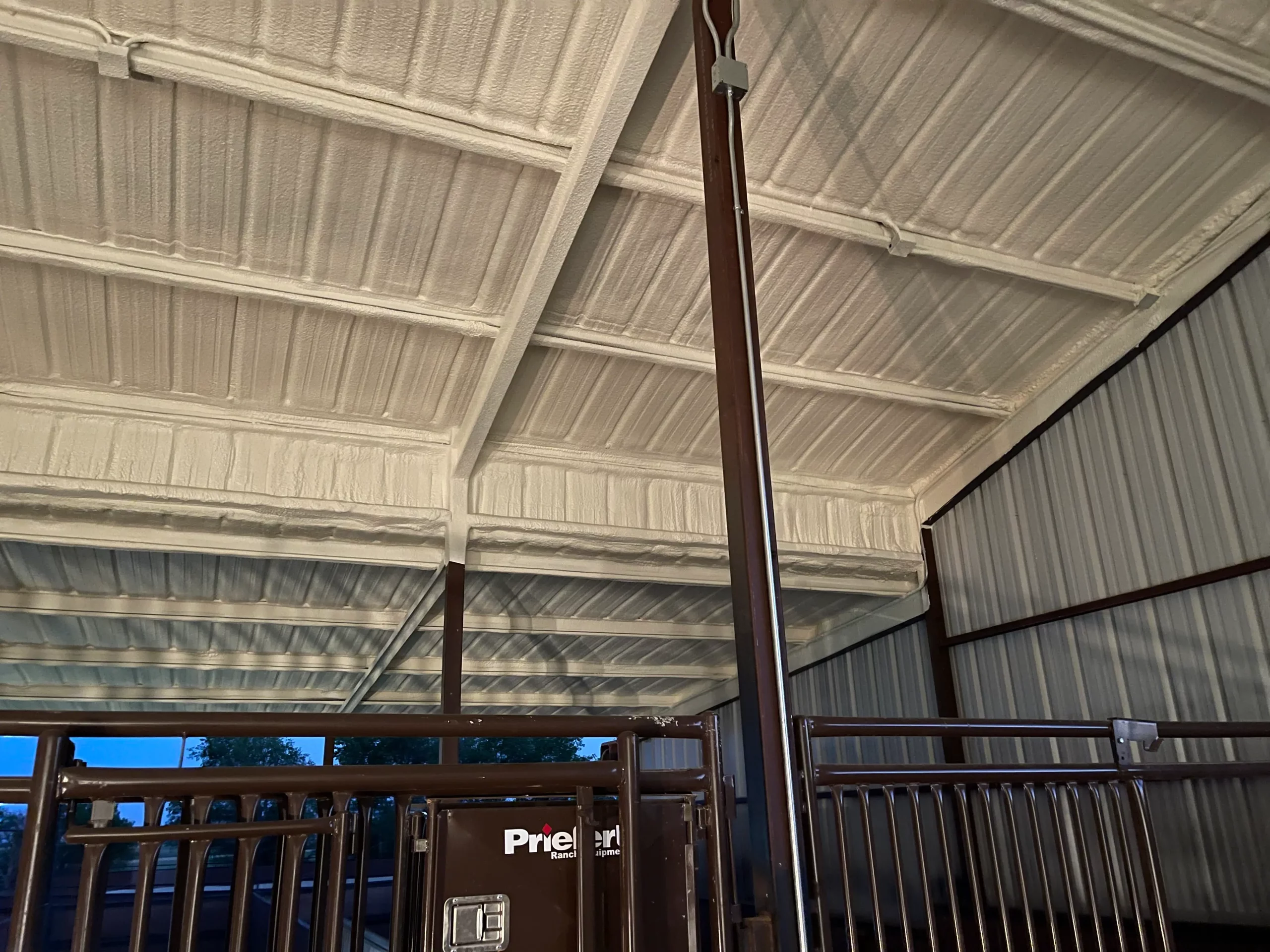
Spray foam insulation air seals metal buildings by expanding as a liquid into every crack, gap, joint, and penetration, then curing into a continuous solid barrier that blocks air movement, moisture intrusion, and heat transfer all at once. In a Worcester climate where January temperatures average 24.1°F and the city sees roughly 64 inches of snowfall per season, that air sealing function matters as much as the insulation value itself. Metal buildings, whether used as warehouses, workshops, agricultural structures, or commercial space, present specific challenges that spray foam addresses directly: widespread air leakage at panel seams, fastener points, and framing connections, along with serious condensation risk driven by warm indoor air meeting cold metal surfaces. The right spray foam approach depends on building use, existing conditions, and whether the structure needs open-cell or closed-cell product.
Metal buildings are constructed from panels, screws, girts, purlins, and framing members joined at hundreds of individual connection points. Each screw hole, each panel overlap, and each joint between a wall panel and a structural member represents a potential air leak. Unlike wood-framed buildings where drywall, housewrap, and sheathing layers create some incidental air resistance, metal buildings offer very little natural resistance to air movement. The panels themselves are thin and conductive, and the fastener patterns create a patchwork of tiny openings that add up to significant total leakage area.
According to Building Science Corporation research, the control of air flow is important for three primary reasons: moisture control, energy savings, and occupant comfort. Airflow across the building enclosure is driven by wind pressures, stack effect, and mechanical equipment. In a metal building during a Worcester winter, stack effect creates strong pressure differences because the indoor-to-outdoor temperature gap can exceed 50 degrees Fahrenheit. Warm indoor air pushes outward through every available path, carrying moisture with it. When that warm, moist air contacts cold metal surfaces inside the wall or roof cavity, condensation forms, and repeated condensation cycles accelerate corrosion and degrade structural connections.
Air leakage also accounts for a substantial portion of total energy consumption. Building Science Corporation notes that approximately 30% to 50% of space conditioning energy consumption in many well-insulated buildings is due to uncontrolled air leakage through the building enclosure. For a metal building where air leakage paths are more numerous and the envelope itself has less inherent insulation, that percentage can run even higher.
Spray polyurethane foam is a two-component material that combines isocyanates and polyols at the spray nozzle, then expands and cures in place. When sprayed onto metal building surfaces, the foam expands to fill the cavity and adheres directly to the metal substrate, the framing, and any adjacent materials. This direct adhesion is what makes spray foam different from batt insulation, rigid boards, or radiant barriers. Those materials sit in or against a cavity but rely on separate tape, caulk, or fasteners to create an air seal. Spray foam IS the seal.
The polyurethane chemistry produces a polymer with a cellular structure that traps gas within closed or open cells. As described in the polyurethane literature, closed-cell foams have intact gas bubbles that provide both high R-value and low vapor permeability, while open-cell foams have broken cell walls that allow some vapor diffusion. Both types form a continuous, adhered layer that meets all five requirements of an effective air barrier system: continuity, strength, durability, stiffness, and impermeability to air.
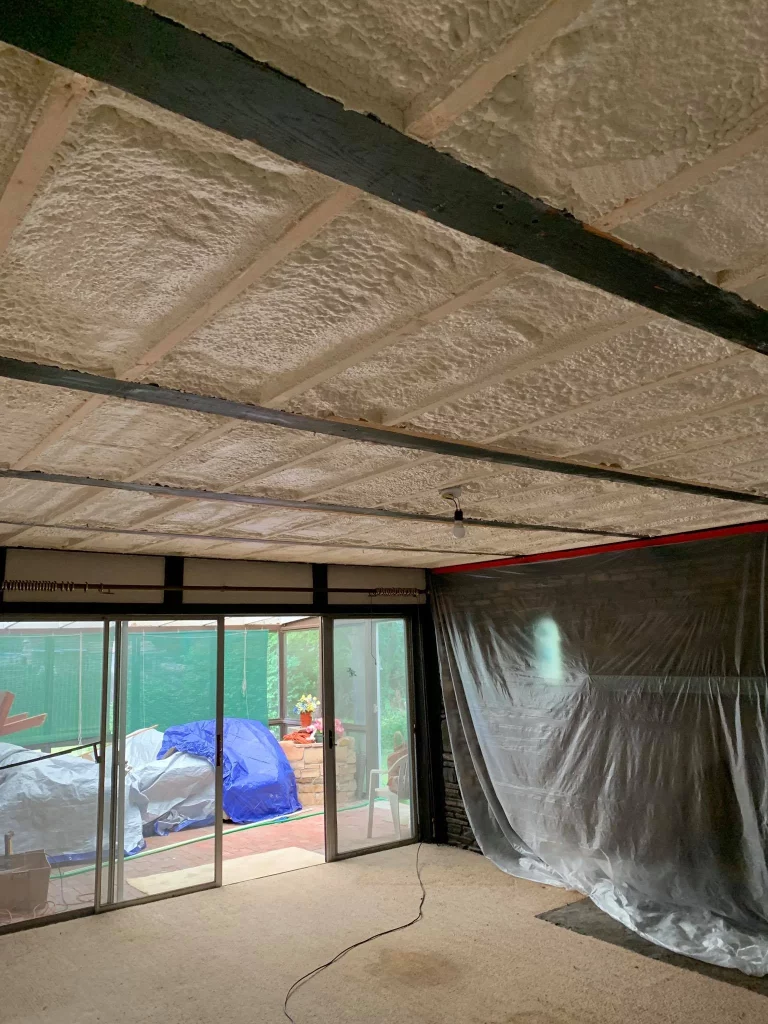
In a metal building, the application typically targets the roof deck (the underside of metal roofing panels), the walls (between or behind metal wall panels), and the perimeter framing where metal meets concrete slabs or foundation systems. The foam fills around purlins, girts, and structural supports, sealing the gaps where these members penetrate the envelope plane. For retrofits, our crews spray directly to the interior face of the metal panels and framing, creating a monolithic layer that locks out air movement at every connection point.
The choice between closed-cell vs open-cell spray foam in a metal building depends on the specific assembly, the building use, and the moisture control strategy. Both provide effective air sealing, but they differ in density, R-value per inch, and vapor permeability.
| Property | Closed-Cell Spray Foam | Open-Cell Spray Foam |
|---|---|---|
| R-value per inch | Approximately R-6 to R-7 | Approximately R-3.5 to R-3.7 |
| Vapor permeability | Low (acts as vapor retarder) | Higher (vapor permeable) |
| Density | High (typically 1.5 to 2.5 lb/ft3) | Low (typically 0.4 to 0.8 lb/ft3) |
| Air barrier function | Yes, continuous and adhered | Yes, continuous and adhered |
| Best suited for | Metal roofs, thin wall cavities, high humidity spaces | Large wall cavities, interior partitions, sound dampening |
| Moisture strategy | Restricts vapor flow (Class II vapor retarder) | Allows drying to interior |
For Worcester metal buildings insulation, closed-cell spray foam is often the preferred choice for roof applications and exterior-facing wall assemblies. Worcester sits in ASHRAE climate zone 5A, and in cold climates, the combination of air sealing and vapor retardancy is important to prevent warm, moist indoor air from reaching cold exterior surfaces where it could condense. Building Science Corporation’s vapor barrier guidance recommends Class II vapor retarders (1.0 perm or less) on the interior of wall assemblies in climate zone 5 where the exterior sheathing has a permeability greater than 1.0 perm, which describes most metal building assemblies.
Open-cell spray foam remains a strong option in specific contexts, such as interior partition walls within a larger conditioned space, or in assemblies where the building design calls for vapor-permeable insulation that allows drying in both directions. Our team evaluates each building’s specific conditions before recommending a product.
Condensation is arguably the biggest threat to an uninsulated metal building in a cold climate like Worcester’s. When warm indoor air carries water vapor and that vapor contacts a cold metal panel, the vapor condenses into liquid water. Over time, this condensation can rust structural connections, saturate insulation, promote mold growth, and drip onto stored contents or finished floors below.
Spray foam insulation in Worcester, MA addresses condensation in two ways. First, it air seals the envelope, reducing the amount of moisture-laden air that can reach cold surfaces in the first place. Second, it adds thermal resistance between the conditioned interior space and the metal panels, which raises the temperature of the interior surfaces above the dew point of the indoor air. When the surface temperature stays above the dew point, condensation cannot form.
Building Science Corporation emphasizes that the fundamental principle of water vapor control is to keep moisture out and let moisture out if it gets in. Spray foam supports both goals: it keeps moist air from penetrating the assembly, and in the case of open-cell foam, it allows vapor diffusion for drying if any moisture does enter the wall cavity.
Worcester’s humid continental climate brings cold, windy, and snowy winters alongside warm, humid summers. The city averages 64 inches of snowfall per season, and winter temperatures regularly drop below freezing. The USDA places Worcester in hardiness zones 5b and 6a. These conditions mean that a metal building without proper air sealing and insulation loses heat rapidly through panel seams, experiences condensation problems during the heating season, and suffers from temperature swings that make the space difficult to heat or cool consistently.
The state of Massachusetts follows ASHRAE 90.1 energy standards for commercial buildings, which establish prescriptive insulation R-value requirements divided by climate zone. In climate zone 5, these requirements specify minimum R-values for walls and roofs that metal buildings must meet. Spray foam helps reach those targets while simultaneously providing the air barrier that other insulation types cannot deliver on their own.
For building owners in Worcester using metal structures as workshops, storage facilities, agricultural buildings, or light commercial space, the combination of air sealing and insulation from spray foam directly reduces heating fuel consumption during the long winter months and improves comfort during summer humidity spikes.
Choosing the right installer is as important as choosing the right product. A few qualitative indicators help separate experienced spray foam professionals from the rest:
Lamothe Insulation and Contracting provides spray foam insulation and air sealing services for metal buildings throughout the Worcester, MA area. Our experienced team evaluates your building’s specific conditions, recommends the right spray foam product for each surface, and applies it to create a continuous air barrier and insulation layer that handles Worcester’s demanding winters. Whether your metal building is a new construction project or an existing structure that needs retrofit insulation, we handle the job from assessment through completion.
Ready to stop air leaks and condensation problems in your metal building? Reach out to our team today.
Request a Free Quote | Schedule a Building Assessment
Call us at (508) 847-0119 or email [email protected] to get started.
Yes, spray foam adheres directly to steel panels and framing, expanding into the profile of corrugated roofing and wall panels to create a continuous seal.
Spray foam reduces condensation by air sealing the envelope to limit moisture transport and by adding insulation that keeps interior surface temperatures above the dew point.
Most metal building projects take one to three days depending on building size, the number of surfaces being sprayed, and whether the building is occupied during application.
Spray foam provides both functions in a single application, eliminating the need for a separate air barrier material like housewrap or rigid board with taped seams.
Closed-cell spray foam is generally the better choice for metal building roofs because of its higher R-value per inch and its ability to act as a vapor retarder in cold climates like Worcester’s.